Spicer Reservoir Fishing Report: Catch Quality Trout Amid Stunning Sierra Views
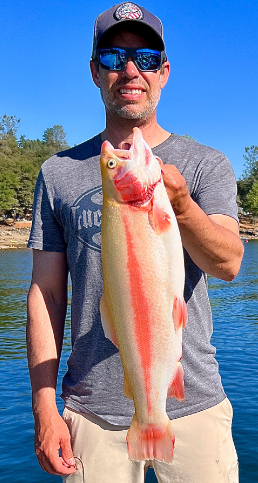
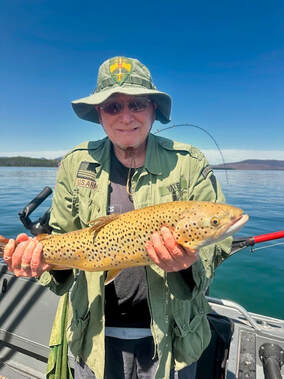
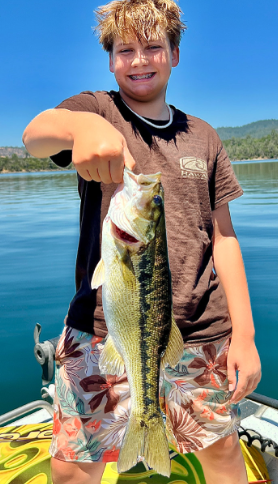
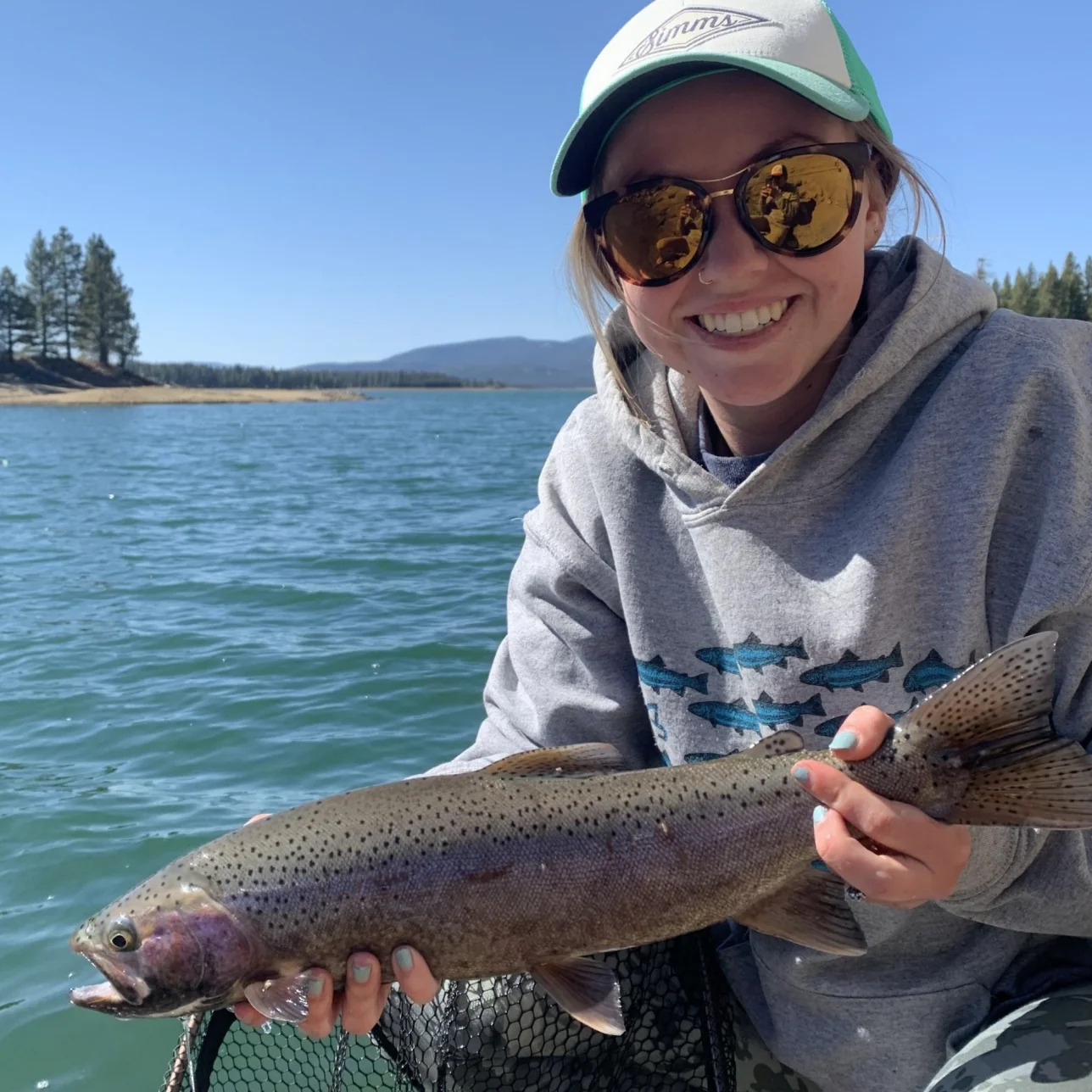
The recent fishing at Spicer Reservoir has yielded impressive catches of rainbows and browns, with anglers enjoying solid success from both shore and boat while surrounded by breathtaking scenery. Whether using lures or bait, the action has been promising as the lake continues to thrive with various trout species.
Fish Reports
What's biting across California, newest first.
📊 Fish Plants Updated for week of 6/22/2025
📊 Fish Plants Updated for week of 6/12/2025
📊 Fish Plants Updated for week of 6/8/2025
SHASTA LAKE SPRING TROUT & SALMON DERBY
By Paul J. Kneeland
The 22nd annual Shasta Lake Spring Trout & Salmon Derby took place on the first weekend of May at Lakehead on the upper Sacramento arm of Shasta Lake. The lake was full to the brim this year and absolutely gorgeous. The Spring derby includes brown and rainbow trout (only 1 brown weighed in per day per team), kokanee salmon and King salmon(only 2 kings per day).
We stayed at the lovely Tsasdi Resort at Lakehead and we had 3 teams in our large cabin, including myself and John Brassfield, Dave Barsi and son in law Mark Talkington, and Kurt and Jen Kock who traveled all the way from Wyoming to fish the derby. We moored all 3 boats at the Tsasdi docks right below the resort.
Thursday evening, we gathered at our nice cabin at Tsasdi and had a wonderful dinner of barbequed steaks, combined with potatoes, green salad and red wine. What a great way to start a long weekend of fishing.
The official derby is always on Saturday and Sunday, so we all pre-fish on Friday to try to get a “lay of the Land” so to speak. Friday morning was clear and beautiful, with a slight north wind and a cool temperature of 45 degrees at 5:30 am. John and I always explore on Friday, going to places we don’t normally fish, saving our “good spots” for the real derby days. We headed out in the Fish Sniffer Rogue Jet Coastal 21 and decided to run up the McCloud arm to see what it looked like. It was a long boat ride with the lake being so full. We started trolling near Dekka’s rock and John landed a nice 19 inch rainbow on a 3 inch Apex at 15 feet deep. That would be a money fish in the derby!
We caught a couple black bass as we trolled downstream. After about an hour with no more trout, we headed down and turned into the Pit River arm. We ran to Silverthorn Resort, and then turned and started trolling west toward the I-5 bridge. We landed 4 rainbows and 1 brown on Friday. All the trout came on different lures, including Apexes, Speedy Shiners and Hot Ticket spoons, with different colors and different depths, so there was no rhyme or reason to any pattern.
Friday evening, we convened at the Bass Hole for drinks and dinner, and good natured comraderie with the other fishermen in attendance. We enjoyed the excellent Basshole Tri Tip sandwich and also the Ruebenator sandwich with homemade fries that filled all of us to the “gills”. Back at our cabin, we had a touch of bourbon and a cigar and tried to figure out a plan for Saturday.
Saturday morning, John and I headed down to the boat about 5:15 am. The weather was beautiful and calm with a temperature of about 50 degrees. We had decided to try the Salt Creek area first thing in the morning. We were trolling by 5:30 eastbound up the arm. We made one pass and hooked 2 trout right at the mouth of the bay. I landed a nicely colored 16 inch brown on a white/red dot Excel spoon behind Vance’s cannonball flashers at 50 feet deep, and John landed a decent rainbow that hit his 00000 spoon on the surface! Again, no pattern that we could follow. We tried fishing the Gooseneck area of the Sacramento arm and still no results. We had not seen any bait and only a few marks on the Lowrance graph wherever we went. Finally, we ran over to Dry Fork and trolled into the northern bay and started marking some trout. We caught a couple in the bay at 30 feet deep and also at 10 feet deep. Nothing real big, but at least we had enough to weigh in.
As we started to head in to the docks, the big black clouds that had been coming in from the north started getting lower – and closer. By the time we reached the dock and started tying the boat down, it was pouring rain and some hail. We got soaked walking the short walk to the truck from the boat! The weigh in for the derby is at the Bass Hole and Brews parking lot in Lakehead. In the rain, everyone in line were trying to stay under the eaves of the building. Most fisherman had caught fish, and the top 10 folks all had at least one brown or rainbow of 3 to 5 pounds in their bag. Big fish of the day was an 6.57 pound brown caught by the Chris Dunham team.
Sunday morning, we were on the boat and heading out before 5:30. The weather had cleared up overnight and cooled off a bit, but no more rain. John and I headed to Waters Gulch where we have had luck before. We trolled back and forth and only caught a couple bass. Then we headed to Dry Fork where we caught fish yesterday. We had talked to a few guys yesterday that said they were catching big salmon and trout in the area – using bait like shad or anchovies behind big dodgers – and 100 to 140 feet deep! We didn’t have any bait, but rigged up with dodgers and hootchies and sent them down deep. There was about 15 boats in the Dry Fork cove, and we only saw one fish caught while we were there. Just not our day, I guess. Finally, late in the day with only one small rainbow in the box, we headed up the Sacramento arm and started trolling in the Elmore Bay area. The big north wind that was promised showed up about noon, and made controlling the boat a bit of a chore. At 2:30 we made the decision not to go to the weigh in and be embarrassed with only one small trout. Friends Mike Burley and Jerry Ford of Foresthill told us they had caught a few trout trolling fast with Rapalas, so we switched up and started trolling at 3 to 3.5mph. John caught a couple on a red/gold Excel spoon and I got a couple on a watermelon Speedy Shiner. In an hour or so we landed 4 decent rainbows!! Finally figured something out! Too late and too little however for competing in the derby.
Back at the weigh in at the Bass Hole, there was a pretty good line up of folks weighing in which is always a good sign. To be in the money, you had to have landed at least one 3 to 5 pound trout. The winning team was the Nick Britto team with a total 2 day weight of 22.51 pounds and the grand prize of $2000. Cash prizes were paid all the way down to 20th place.
The Shasta Lake Trout derbies are always a lot of fun for all of us. Shasta Lake is an amazing fishery, not only for trout, but for bass, crappie, king salmon and now kokanee! The derbies feature an included dinner at the Lions Club in Lakehead with excellent food and great camaraderie. The weigh ins are always produced at the remodeled Bass Hole and Brews bar and grill in Lakehead that features many craft beers, great cocktails and good food.
We stayed at the lovely Tsasdi Resort in Lakehead. Tsasdi features 20 cabins with one, two or 3 bedrooms, plus heated swimming pool, 230 foot concrete dock, game room, satellite TV and much more. They also have an incredible venue for weddings, retreats and reunions. For more information, give them a call at 530-238-2575 or go to www.tsasdiresort.us
For more information on the Spring Trout & Salmon Derby held in May of each year, go to www.kokaneepower.org. The Shasta Lake Fall Trout Derby held in October of each year is presented by the Shasta Lake Business Owners Association. For information, go to www.shastalaketroutderby.com
Cutlines
Photo 1: Chris Dunham admires the 6 pound brown he caught on Saturday morning at the Shasta Lake Spring derby. Photo courtesy of Mary Dunham
Photo 2 Photo 2 — John Brassfield of Foresthill shows off a nice king salmon taken from Big Backbone area of Shasta Lake. (photo by Paul Kneeland, Fish Sniffer staff)
Photo 3
Ominous black clouds coming from the north brought a downpour on the weigh in for the Shasta Derby on Saturday.
(photo by Paul Kneeland, Fish Sniffer staff)
Shasta Spring Derby 2025 Top Ten Teams
Nick Brito Team 23.51 lbs. 17.23
Dale Gibbons Team. 22.98 lbs. 16.54 Mike Giovacchini Team 22.28 lbs 16.48 Kenny MacDonald Team 22.18 lbs 14.59 Chris Dunham Team 21.94 lbs 14.45 Richard Contrearas Team 20.59 lbs 14.33 Kevin Smith Team 19.52 lbs 14.23 Dave Koistinen Team 17.84 lbs 13.91 Craig Perry Team 17.70 lbs 13.69 Butch Jacobson Team 17.12 lbs 13.38
Cutlines:
Photo 1: Chris Dunham of Roseville admires his 6 pound brown that won the Big Fish prize for Saturday at the Shasta Lake Spring Trout & Salmon derby. Photo courtesy of Mary Dunham
Photo 2 — John Brassfield of Foresthill shows off a nice king salmon taken from Big Backbone area of Shasta Lake. Photo by Paul Kneeland, Fish Sniffer Staff
Photo 3 – Menacing dark clouds coming from the north poured rain on the weigh in line on Saturday at the Shasta Derby. Photo by Paul Kneeland, Fish Sniffer Staff
Delta Tunnel opponents slam Gov. Newsom’s revised budget plan to fast-track project
SACRAMENTO - Sacramento — Governor Gavin Newsom in May announced, as part of his May Budget Revise, a controversial proposal to fast-track and “streamline” the Delta Conveyance Project, AKA Delta Tunnel. Newsom claimed the project would advance “much-needed and long-overdue improvements to the State Water Project,” while a coalition of Tribes, fishing groups, environmental justice organizations, Delta water districts and Delta counties and cities say the project would do irreparable harm to the San Francisco-Bay Delta ecosystem and Delta communities. Echoing the Trump Administration’s plans to export more Delta water to agribusiness billionaires and Southern California water brokers, Newsom stated, “For too long, attempts to modernize our critical water infrastructure have stalled in endless red tape, burdened with unnecessary delay.” “We’re done with barriers — our state needs to complete this project as soon as possible so that we can better stores and manage water to prepare for a hotter, drier future. Let’s get this built,” said Newsom. The Governor’s Office also claimed that “If the service area of the State Water Project were its own country, its economy would rank eighth largest in the world, generating $2.3 trillion in goods and services annually.” Specifically, Newsom’s proposal would streamline the project by: • “Simplifying permitting. The proposal would simplify permitting for the project by eliminating certain deadlines from existing State Water Project water rights permits — recognizing that the State Water Project should continue serving Californians’ water needs indefinitely. The proposal would also strengthen enforcement of the Water Board’s existing rules for permit protests. • Confirming funding authority. The proposal confirms that the Department of Water Resources has the authority to issue bonds for the cost of the DCP, to be repaid by participating public water agencies. • Preventing unnecessary litigation delays. The proposal narrows and streamlines judicial review of future challenges to the Delta Conveyance Project, building on models that have served other large public works projects. • Supporting construction. The proposal streamlines the authority to acquire land, supporting ultimate construction of the Delta Conveyance Project.”
Restore the Delta: “An alarming effort to bypass longstanding processes”
But Delta Tunnel opponents quickly condemned what they described as “an alarming effort to bypass longstanding legal, environmental, and public participation processes in order to fast-track the controversial Delta Conveyance Project” — a massive 45-mile long underground water tunnel that would divert water from the Bay-Delta to industrial agriculture and wealthy water agencies in Southern California.
‘The Delta Conveyance Project is legally a ‘beneficiary pays’ project — meaning the water users who benefit must cover the costs,” said Barbara Barrigan-Parrilla, Executive Director of Restore the Delta. “Yet today, the Governor wants to bypass the legal and public processes because the project doesn’t pass the economic or environmental standards Californians expect.”
“$20.1 billion before Trump-era tariff inflation, construction overruns, and interest means this tunnel could cost up to $60 billion — for a system that would sit dry frequently due to climate-driven water scarcity. There is a better way, and the real water leaders in California know that,” she stated.
In response to Newsom’s plan, Restore the Delta pointed out that by “cutting red tape,” Newsom’s proposal would actually:
• Eliminate permit deadlines designed to protect water rights and ensure fair process;
• Drastically reduce judicial review, making it harder for communities and Tribes to challenge harmful impacts;
• Expand eminent domain authority to seize land for tunnel construction;
• Cement funding mechanisms without transparent oversight or accountability to taxpayers.
“This proposal strips Californians — especially those in the Delta region — of their right to be heard on one of the largest, most environmentally risky infrastructure projects in state history. It’s a power grab disguised as climate adaptation,” said Barrigan-Parrilla.
“California’s climate challenges are real — but a tunnel is the wrong response. Investing in local, distributed water solutions like stormwater capture, wastewater recycling, groundwater recharge, and water efficiency would deliver more reliable results at a lower cost and with greater local job creation,” she continued.
“How can the state afford a $60 billion tunnel when we’re already losing $16 billion due to new federal tariffs?” asked Barrigan-Parrilla. “And how does forcing this extremely costly and outdated project onto Californians make the state more affordable — especially when local water solutions are proven to cost less and deliver more?”
She said Newsom’s proposal “directly contradicts the Legislature’s stated goal of making California more affordable.” It would force higher water rates on millions of Californians — especially low-income residents in Southern California — to pay for a project that benefits the few at the expense of the many.
“This is not climate leadership. It’s a top-down push for an unaffordable, unnecessary tunnel that fails to solve the state’s real water challenges. We call on the Legislature to reject this budget proposal and protect public process, affordability, and real solutions that work for all Californians — not just the biggest water agencies,” Barrigan-Parrilla concluded.
Golden State Salmon Association: “A nail in the coffin” of salmon runs Scott Artis, Executive Director of the Golden State Salmon Association, also weighed on the Governor’s proposal to “streamline” the Delta Tunnel permitting process. “The Governor’s proposal is a Trump-style attack on the salmon fishing industry and the state’s biggest rivers. Commercial salmon fishing has been shut down for three straight years because of crashing salmon runs,” he observed. “Now the Governor is proposing to slash protections to build the biggest salmon-killing project in the state.” “Climate change is making our state hotter and drier. Spending $20 billion on the Delta tunnel for climate resilience is like building more horse drawn buggies to make transportation more climate friendly. Smart water agencies know that there’s a far better source of abundant climate-smart water supply — water recycling, water use efficiency, stormwater capture, groundwater storage, and more,” he stated. “All of Central Valley agriculture decided years ago that this project was not worth the astronomical cost. The Governor and Big Ag are hoping they can sucker Southern California and Silicon Valley ratepayers into paying for this boondoggle,” Artis added. “At the end of the day, this proposal is a nail in the coffin of California’s once mighty salmon runs, a stake in the heart of the Delta, and a raid on the pocketbooks of the people of Southern California and Silicon Valley,” Artis said.
Save California Salmon: “Don’t destroy the Bay-Delta” “Governor Newsom’s efforts to force approvals for the Delta Conveyance Project ignores long standing objections from Tribes, Delta communities, and commercial fishing families,” said Regina Chichizola, executive director of Save California Salmon. “Moving this unpopular project forward has been subject to laws and public review for a reason.” “Californians oppose this project because it will cause irreversible harm to water quality, salmon, communities, and the fragile Delta ecosystem while providing marginal, and unreliable, benefits to the rest of the state. When the governor was elected, he promised to protect California’s environment. Now he calls for the stripping of critical public protections and selling our water to the highest bidder. It is getting harder and harder to see the difference between Newsom and Trump,” she stated. “Making an end-run around essential processes won’t make destroying the Delta a better idea,” continued Chichizola. “This proposal continues to perpetuate a water rights system that lines the pockets of large agricultural producers while working people are left high and dry. Regular Californians deserve to have a say, and environmental protections, when it comes to our most important resource, clean water.”
Food & Water Watch: “Unnecessary, harmful and expensive project”
Food & Water Watch California Director Nicole Ghio released the following statement regarding the Governor’s proposal: “Our Governor is absolutely correct that climate change has had a significant impact on our state’s water supplies, posing a major risk for millions of Californians that need and deserve clean, safe drinking water. However – as we have been saying for years – the Delta Tunnel is not the answer. “Rather than recklessly fast-tracking this unnecessary, harmful, and expensive project that will mainly benefit corporate agribusinesses and other powerful interests, Governor Newsom must hold major polluters accountable and immediately rein in the water abuse by the big agribusiness and fossil fuel corporations that guzzle up billions of gallons of California’s water.” .”
Potluck Time in the City by Jack Naves ‘When Worlds Collide’ is a way of expressing different opposing things coming together into a single moment. One example would be a huge international city like San Francisco being only minutes away from world-class halibut and striper fishing. When most of us think about fishing, we imagine getting back to nature and escaping the city. On a more scaled down level, the fishing opportunities that Sacramento offers are another example of worlds colliding. Within earshot of roaring freeways and blasting train horns, the Sacramento and American Rivers provide metropolitan fishing to over two million nearby residents. While most of us need departure from the city at some point, the convenience of making a quick trip to a nearby location can be the difference between fishing or staying home! This time of year, potluck opportunities present themselves to anglers fishing the Sacramento, American, and Feather River systems. Now is the time to try your luck for striped bass and shad within the city limits and bustling freeways. I was lucky enough to get into the action during two recent potluck trips in the city of Sacramento. On May 25, I had a scheduled trip with Max Wagner of Eugene, Oregon. Not knowing exactly where we would be fishing, some other plans came up just before the trip. I was originally thinking about fishing at Bullards Bar for kokanee, but it is over ninety minutes from my house. Not to worry, I told Max, we could still fish the nearby Sacramento River in the morning and be back home in plenty of time. Timing the striped bass spawning run through Sacramento can be very unpredictable. For those of us fishing in the city, the fish often shoot up past us while we are busy with other plans. I let Max know that striper fishing in late May is usually past its prime, and we’d most likely spend our time focusing on American Shad instead. However, we would throw out some bait first thing in the morning to see if any stripers were around. We arrived at Discovery Park at a quarter after five o’clock in the morning on May 25. As light made its first dim appearance, I motored the boat upriver to an inside bend across from ‘Crawdads on the River’. Once I anchored up and killed the motor, we could hear the whooshing sound of tires laying ground on the concrete of nearby Interstate 5. Suddenly, the urban sound was contrasted by the familiar cry from a pair of magnificently colored wood ducks flying past us in full spring plumage. After we deployed our circle hooks baited with chicken livers, I started tying up baits on additional leaders. Out of the corner of my eye, the rod directly to my left pumped down, up, and then slammed down almost to the water. I dropped the bait and quickly grabbed the rod. The rod loaded up heavy, and I announced to Max, “It’s a keeper”. The water was moving fast due to pulse dam releases, and the fish made several runs before Max scooped it into the net. It was a skinny twenty-six-inch striped bass making its run back to sea after spawning up north. About an hour later I landed another fish of similar size, but the bite slowed so we motored downstream in search of American Shad. There were at least three-dozen boats anchored up below the mouth of the American River. We anchored below the fleet and deployed Dick Nite spoons on dropper setups in eight feet of water. The shad fishing wasn’t as red-hot as I had expected; we only landed three shad and lost one. We called it a day at ten o’clock and were back at my house within a half-hour. Motivated by the surprisingly good striper action, I planned another trip for the following morning. I decided to change things up and fish at a more striper-friendly location near Garcia Bend the next morning. This area of the Sacramento River is about eight miles south of downtown, but still within the city limits. On that morning, Jason Carlisle of Elk Grove met me at the ramp, and we motored to a spot I started fishing with my dad back in the early 1980s. We anchored up in sixteen feet of water, and right off the bat my second rod was slammed by our first keeper striper of the morning. It was barely over the eighteen-inch minimum size, so I released it back into the debris-filled river. The pulse flows from the dams upriver stirred up quite a mess of floating leaves, sticks, logs, and occasional trees. However, this didn’t deter the striped bass from being active, as Jason’s rod bent down hard, and it wasn’t from a floating piece of wood. Jason’s fish made a wild run from the port side of the boat under all the lines and up the starboard side. After several line-stripping runs, I finally got a glimpse of the fish and ran the net into the water without hesitation. “Nice one!” I exclaimed, and quickly unclipped the leader so Jason could get a fresh bait back into the water. His fish weighed about six-and-a-half pounds, another beautiful late-spring Sacramento striper! I followed it up with another keeper, and then another nice fish which I quickly released. It was time to try for shad once again. Just like the previous morning, the shad scene was devoid of action. In fact, we only hooked one shad that shot to the surface, jumped, and threw the hook before Jason could even get the rod out of the holder. That’s the beauty of potluck fishing on the Sacramento River. What was anticipated to be a weekend of shad fishing instead turned into two solid striper trips. As spring transitions into summer, the shad fishing around the Sacramento Area should pick up. However, don’t forget to bring along some bait just in case some downrunner stripers just happen to be making their way out of town. Even a quick morning trip can yield limits of tasty white fillets if your timing is right. Sometimes fishing close to home can offer the best of colliding worlds (and fish species!) Photos – Crop as Needed Photo 1 - Max with Shad Max Wagner of Eugene, Oregon poses with a feisty American Shad within the backdrop of downtown Sacramento on May 25. The morning illustrated that you could find great fishing right within the capitol city of California amongst the traffic, trains, and…Major League Baseball? Yes, the Phillies and A’s started playing just beyond the skyscraper about three hours after this photo. Photo by Jack Naves, Fish Sniffer Staff Photo 2 - Jack with 26-inch Striper The author shows off a 26-inch striped bass that slammed a circle hook baited with chicken livers on the morning of May 25 on the Sacramento River. Jack was fishing near Crawdads on the River within the city limits of the state’s capitol. Photo by Max Wagner, Eugene, Oregon Photo 3 - Jason with 6lb Striper In this photo, Jason Carlise of Elk Grove hoists a hefty spring-run striped bass on the morning of May 26. Jason landed the six-pounder using chicken livers baited on a circle hook on the Sacramento River near Garcia Bend in Sacramento, CA. Photo by Jack Naves, Fish Sniffer Staff Photo 4 - Jack with Released Striper This early-morning striper was caught and released by Jack Naves on May 26 near Garcia Bend on the Sacramento River. Jack has been fishing this area since the early ‘80s, and enjoys hearing the same familiar calls of Kingfishers, Swainson’s hawks, wood ducks, and other birds that frequent the peaceful area in the springtime. Photo by Jason Carlisle, Elk Grove Staff Tackle Jack Naves fished with Max Wagner on the Sacramento River in Jack’s 20’ North River Seahawk powered by Yamaha. They caught striped bass using BnM Fishing West Point Crappie Rods teamed with Abu Garcia Ambassadeur C3 reels loaded with 65-pound test Power Pro green braided line. They also landed American Shad using Edge Mag Pro rods teamed with Dick Nite #0 pink/chartreuse spoons on dropper rigs made with Berkley Trilene XL clear 10-pouund test line.
Anglers Target Quality Rainbows and Browns at Beautiful Spicer Reservoir
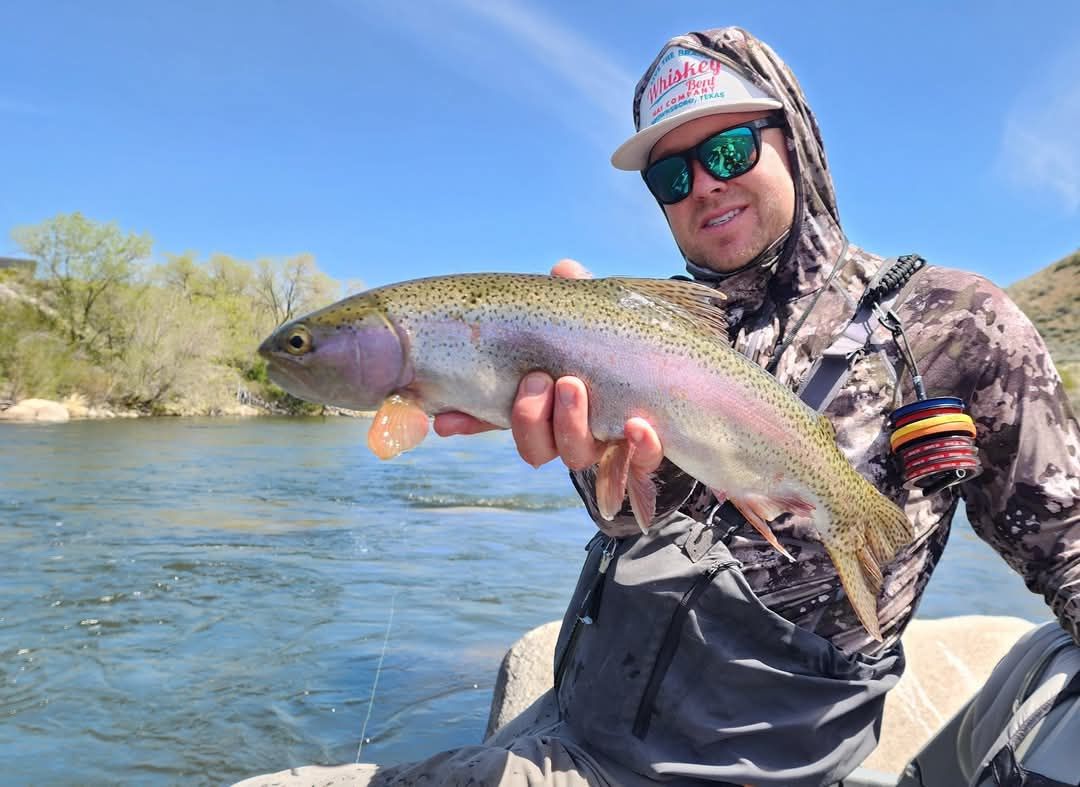
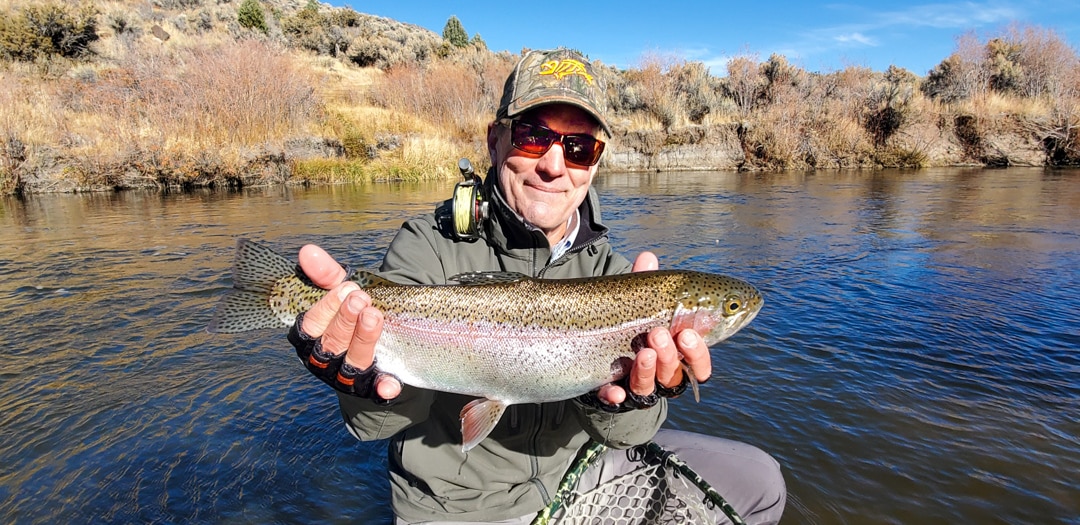
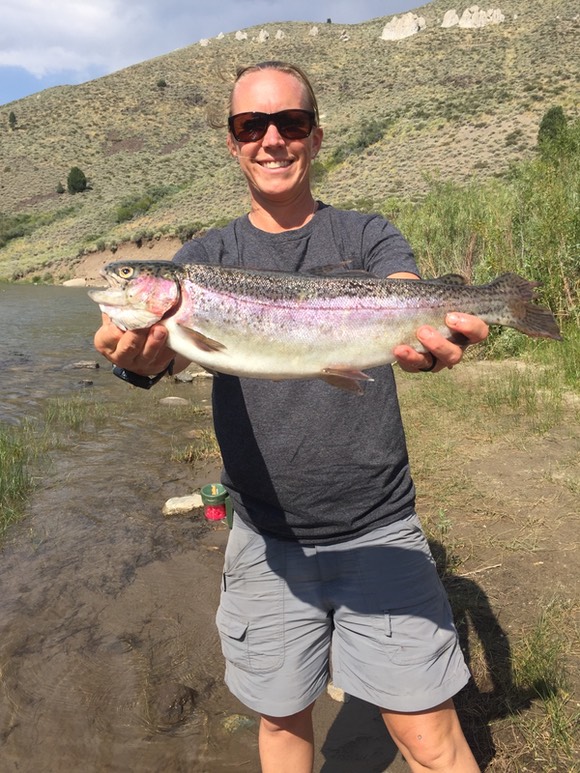
ARNOLD - Spicer Reservoir, located in the North Fork of the Stanislaus River watershed, offers shore and boat anglers a chance to battle gorgeous square-tailed rainbows and brown trout grown out from fingerlings or the progeny of wild trout spawning in Hobart Creek, Highland Creek and other lake tributaries.
The lake also features a sleeper population of brook and Lahontan cutthroat trout, according to CDFW creel surveys.
On Memorial Day weekend, Bill Reynolds of Ebbetts Pass Sporting Goods reported that the road to Spicer Reservoir from Highway 4 had just opened.
“Anglers have been catching limits of rainbow trout, with some brown trout mixed in, from shore and boats throughout the lake,” he said. “Trollers are toplining with an array of lures, while shore fishermen are throwing Power Bait, nightcrawlers and Rapalas.”
Spicer is one of my favorite reservoirs to fish for trout in the Sierra Nevada Mountains. On my most recent trip to Spicer the lake was stunningly beautiful. Fly fishermen in kayaks fished back and forth near the dam, with snow-covered peaks jutting up in the distance as fluffy white cumulus clouds moved slowly across the azure blue sky.
There were several groups of anglers fishing off the bank near the dam, but I didn’t see anybody hook anything while I was there for ten minutes, so I headed to the boat ramp area. Fly fishing enthusiasts fishing in small boats were working the waters of Hobart Creek where it enters the lake.
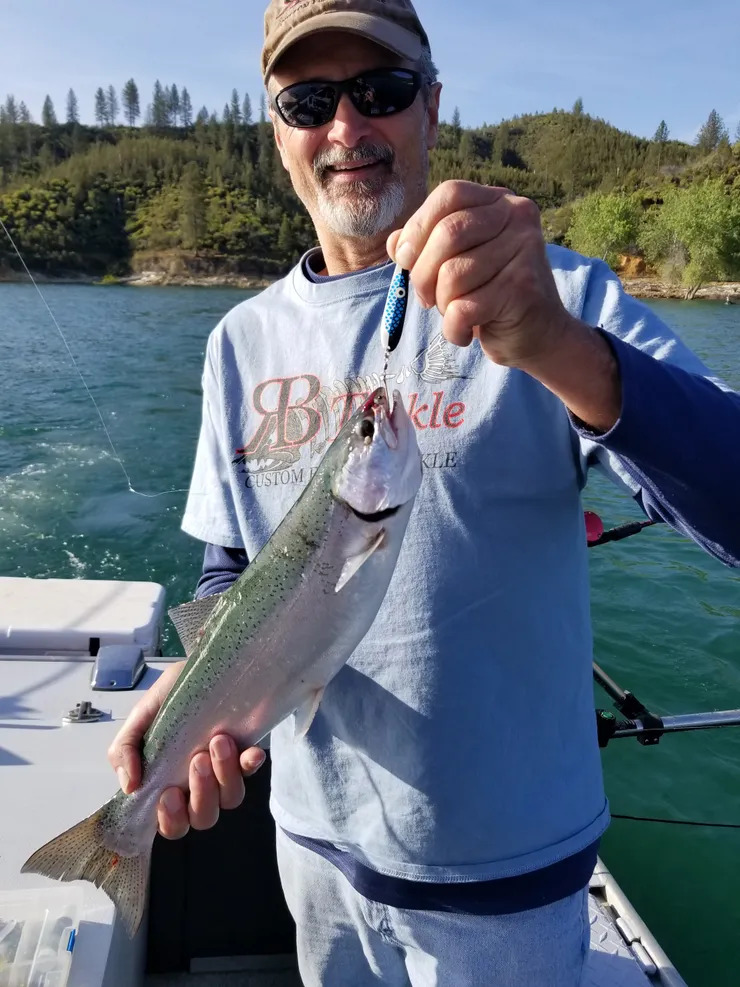
The first bank angler I saw fishing the lake near the boat ramp reported catching and releasing two rainbow trout around 16 inches while throwing a black and gold Panther Martin.
I tossed out a ¼ oz. gold Kastmaster into the reservoir without success. So I switched over to bait fishing with the Tequila Sunrise PowerBait that Reynolds recommended. On my first cast at a different spot, I hooked and landed a 14 inch rainbow.
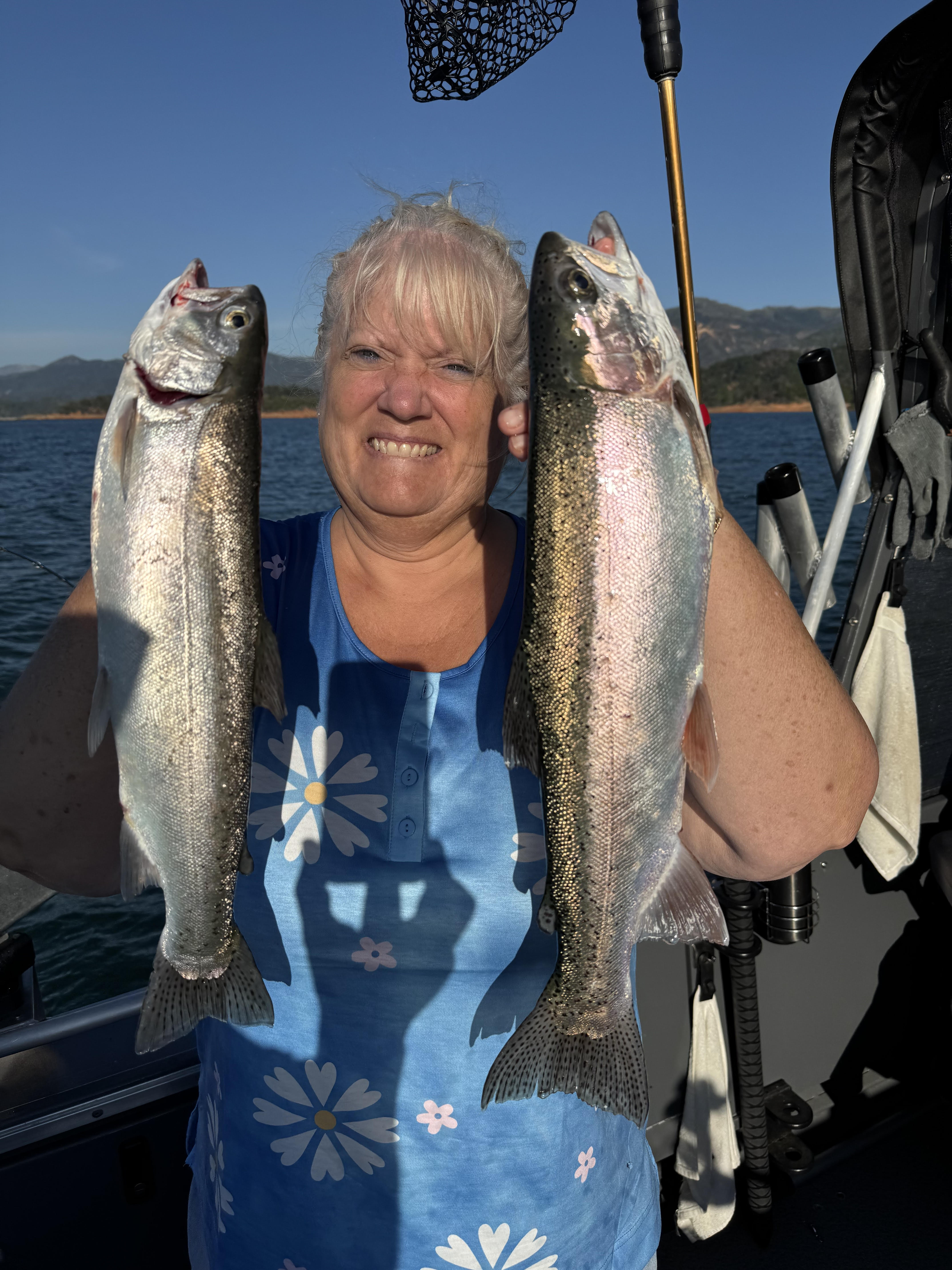
For the next hour, the action was great, with me hooking a fish nearly very cast. These fish were beautiful, slender rainbows in the 14 to 16 inch range. I kept a total of four trout.
The creek is open to fishing from the Saturday preceding Memorial Day through September 30.. Only artificial lures may be used. The limit on the creek is 2 trout, while the limit on the lake is 5 trout.
Spicer features both a “put and grow” hatchery supplemented fishery and a wild trout component that spawn’s in the lake’s tributaries, according to a report on the lake completed by Ben Ewing, CDFW district fisheries biologist, in December 2017.
The reservoir received 50,000 Eagle Lake Rainbow fingerlings in June 2021, 48,000 brown trout fingerlings in May 2022, and 25,000 Eagle Lake Rainbow fingerlings in June 2022. Spicer received 50,000 Eagle Lake Rainbow fingerlings and 120,000 brown fingerlings in 2023.
Spicer, formally called New Spicer Meadow Reservoir, is located in eastern Tuolumne County and western Alpine County 39 miles south of South Lake Tahoe. Spicer is formed by the New Spicer Dam on Highland, Hobart, and Wilderness Creeks, with additional water diverted from the North Fork Stanislaus River, according to Ewing.
Spicer is owned by Calaveras County Water District (CCWD), operated by Northern California Power Agency (NCPA) and permitted by the United States Department of Agriculture (USDA) and United States Forest Service (USFS). Spicer drains into Highland Creek, which flows into the North Fork Stanislaus River watershed.
When the expanded reservoir first filled in 1990, the influx of nutrients into the reservoir created a relatively rich food chain that allowed rainbows to grow to large size, including some fish in the 3 to 5 pound class. However, the lake’s nutrients have declined over recent years, accounting for smaller, though still healthy fish in the catches.
The CDFW has stocked Spicer since 1953 for recreational fishing. Historically, Spicer was stocked with rainbow trout and brook trout. Currently, CDFW only stocks fingerling- size rainbow and brown trout in Spicer, which is managed as a “put and grow” fishery, said Ewing.
“Spicer currently has a recreational fishery including brook trout, Lahontan cutthroat trout (LCT), brown trout (BN) and rainbow trout (RT),” Ewing stated. “Historically, Spicer had a brown bullhead fishery. Spicer is open year-round with a five-trout bag limit with 10 in possession regulation. “
In order to assess the fishery, CDFW installed an angler survey box (ASB) at the public launch ramp in 2015. Anglers were asked to complete a voluntary survey form related to their fishing experience.
In the report completed by Ewing in December 2017, he noted the catch per angler for bait anglers was higher than any other form of gear used in 2018, which also had the highest catch per angler average in 2015..
“Most fish caught were RT for a third consecutive sampling season, which is consistent with the stocking records,” he stated. “Although RT continue to be the greatest single species caught, Lahontan cutthroat trout made up 36.4% of the total catch in 2018. This indicates Spicer has a large, wild LCT population.”
Although Spicer continues to have high catch rates, the great majority of fish caught continue to be under 16 inches, noted Ewing.
“It is unknown why there have been so few trophy-size fish being caught. Salmonids are generally considered as opportunists. New Spicer is a large reservoir with a large population of baitfish, including golden shiner and speckled dace that would likely be a great forage base for trout. Although few-trophy- size fish have been reported, it is possible they are being caught and not being reported or present, but not being caught,” Ewing wrote.
“Anglers at Spicer have the opportunity to catch a variety of catchable-size salmonids that are in great physical shape and often fight with greater force than a ‘put and take’ hatchery trout,” he concluded.
How did Lahontan cutthroat trout get into the lake? Here are the probable reasons why, according to a CDFW report published in 2013.
In 1968 and 1977, Summit Lake in Alpine County received fingerling LCT. The outlet of Summit Lake flows into Hobart Creek, a tributary to Spicer. There is also a record of LCT x RT- Kamloops being planted in upstream in Highland Lakes #1 in 1977. It is possible that these LCT were spillover from the 1977 plant.
“These LCT could have also been pumped in with the water that is diverted from the North Fork Stanislaus River to Spicer by the NCPA, but may have been transplanted illegally or accidently mixed in with a Department RT plant,” the report noted.
I have found the best fishing on this lake during the spring and early summer after the lake becomes accessible and then again in the fall just before the snow arrives. While I have caught fish here in the morning, I find the best time to hit the lake is in the late afternoon just before dark.
For more information about fishing Spicer Reservoir and other Ebbetts Pass Region waters, contact Ebbetts Pass Sporting Goods at (209) 795-1686, https://ebbettspasssportinggoods.com.
The California Fish & Wildlife has updated the 2025 plants for inland chinook salmon and kokanee. Chinook: This year’s IHN infection rate for returning Chinook was very high and negatively impacted this brood year. Out of four lots, the first three were destroyed due to extremely high IHN infection rates. The fourth lot passed, with low IHN infections, and those Chinook were planted in four lakes – Lakes Berryessa, Don Pedro, Pine Flat and Spaulding. Kokanee: This was a good year for kokanee brood, our expected allotment for kokanee was 705,000 fingerlings and DFW planted 755,969. Expected allotments per lake were either met or exceeded; with Shasta getting more than planned and even Indian Valley getting a plant, which was unexpected. 2027 should be a good fishing year for kokanee, barring any unusually dry winters; Although Chinook options will be reduced, given the level of IHN this year, we did get plants into at least three lakes. Plants per lake are listed below. Information courtesy of the California Inland Fisheries Foundation, Inc – also know as Project Kokanee.
Lake Almanor
Trout all over the lake as the water warms up
A little bit of everything as far as conditions go over the last week. We have seen sunny flat calm to big wind, clouds, rain, ect. ect. Inconsistent conditions have made for an inconsistent bite. The water level is on the rise currently sitting just below 4492 ft. or about 2 feet from full. Hamilton branch has seen dramatic improvements in water clarity flowing into the lake. Water temperatures are currently running in the mid to upper 50’s ticking up on the sunny days. Bug hatches are coming on strong all over the lake and fish tailing at the surface can be seen taking advantage of the fresh food supply. The trout are now widely spread throughout the entire lake. Action for trollers is happening at a variety of locations around the lake, from the dam to Dorado and even up by Big Springs, as the water color has improved so has the bite. Both sides of the peninsula have also been giving up fish as is the west shore from Rocky Point to Almanor West giving anglers plenty of locations to visit. Trout have been caught on a wide variety of offerings, with lots of options for anglers. Worms plastics and trolling flies along with fast trolled spoons have all produced fish this week. The surface to 30 feet seems to be holding the bulk of the active fish. The catch continues to be a mix Rainbows and Browns along with a few salmon. The Smallies are active as well in the shallows. Bait fishermen have been netting a few fish at various locations including Dorado, the dam and Red Bank. Fly anglers suspending nymphs under indicators are tempting the fish that are keyed in on the bug load coming off the bottom. Boat ramps and docks that are in and useable include. (This list includes public and private facilities.) Canyon Dam USFS West Shore, Plumas Pines (limited docks gas available 5/23), Almanor West, Rec 1, Rec 2, Multiple Resorts in Big Cove (gas available), Hamilton Branch HOA The weatherman says we are in for a run of nice weather, look for the warmer temps to expand the bug hatches and ramp up the bite. Report courtesy of the Almanor Fishing Association.
Lake Berryessa
Limits Of Kokanee Highlight Trolling Catches
SACRAMENTO – If you want catch a limit of kokanee, as well as good numbers of rainbow trout and some king salmon, now’s the time to book a trolling adventure on Lake Berryessa.
“This morning we had Michael and Jordan from Idaho back out once again on Berryessa searching for more Kokanee action and they limited out again,” reported Nate Kelsch of Big Nate’s Guide Service after his latest trolling adventure. “Not only did they score limits of kokanee, with all fish being extremely fat and healthy, but they had a couple donkeys in the mix, and got 7 big Eagle Lake trout and 1 nice king salmon for the crew by noon.”
“We also lost a few nice kokes right behind the boat,” he continued. “The epic train rolls on. This lake is fishing as good as I’ve seen it in years and continues to provide exceptional action for my clients. The Fish America Kokanee Dodgers, with Tpex lures and Uncle Larry spinners, continue to dominate our catches between 20 and 60 ft.”
On his previous trip, he also reported outstanding kokanee, king and trout fishing.
“Today had Tom, Bob and Ken out on Berryessa for a potluck trip and they crushed them. They scored donkey kokanee and king salmon and rainbow trout and even caught a huge Sacramento pike-minnow. We had everything wrapped up by noon, with 21 fish to the boat. A couple of fish also broke us off – and numerous fish didn’t stick. A couple of fish broke us off.”
“Once again I stayed away from the fleet to the best of my ability, and it paid dividends. There are fish all over the lake, If you put in some time and find your own fish, your success rate will go up exponentially. Catch America gold, orange, and pink dodgers, paired with Tpexes and Uncle Larry’s spinners in various patterns, crushed them once again. Chrome Killer Corn is another key element to this epic bite we were on.”
“We caught fish from the surface down to almost 70 ft chasing marks on my graph and those marks are turning into fish on ice in our bag! We are now booked solid thru June and only have a few dates available for July and August is starting to fill up as well,” Kelsch added.
Bass fishermen are also experiencing epic fishing on Berryessa. “The bite has been red hot, with packs of bass feeding on shad,” reported Don Paganelli of Paganelli’s Bass Fishing Experience. “On one trip, the top water bite at Lake Berryessa was completely off the hook. We caught and released more than 75 bass, all on top water lures. White Blade Runner spinner baits also caught a few, along with a few small swim baits.”
Reclamation now requires all boats launching at Lake Berryessa to participate in a seal program to prevent the spread of invasive golden mussels. All vessels wishing to launch at Lake Berryessa will be inspected, according to the Bureau of Reclamation:
A red quarantine seal will be applied for 30 days during which the vessel will not be permitted to launch. Vessels that have finished the 30-day quarantine may return to the lake and have the seal removed by authorized staff and will be allowed to launch.
For questions about this new protocol and vessel decontamination, contact BOR-Berryessa@usbr.gov.
Lake Berryessa is holding 1,523,794 feet of water, 95 percent of capacity and 115 percent of average.
Collins Lake
Bass Still Biting, Trout Take a Dive
OREGON HOUSE – There’s Just a few more quiet days before summer comes crashing in! The lake is about 2 ft. below full with a surface temperature around 74°F and good clarity. There are good reports of bass and redear activity over the last 10 days, expect the bass to settle for spawning soon.
Trout are still biting but for the most part they have taken a dive down below 15ft. That’s how deep Cooper Meadows caught his 8.16lb lunker trout on a pink rubber worm over on the east side.
Angelina, 7 and Julian, 3, brought home dinner for the whole family with 8 rainbow trout caught on green PowerBait down below site #312. Lindsey and Bertoni brought in a double limit including a 7lb beast trolling near the dam.
Lilyanne Shaun and Conner loaded up the bragboard with rainbow trout and lightning trout, as did Joe Malotte and Carl Lincoln, who used PowerBait and nightcrawlers at only 10ft deep.
As the weather warms up we expect to see more catfish like the 10 pounder that Yashua caught on a worm. Greg Dawn caught a limit of trout and topped off his ice chest with a bass caught trolling worms and PowerBait with an old classic- anise oil.
Victor of Yuba City caught a 2.5 pound lightning trout, Waylon’s weighted in a 2.2 pounds and Nickey showed us what a 9 pound fish looks like.
Lilyanne caught her 2.5lb lightning trout on Pink Trick Worms. Ryan Alexander caught an 8 pound rainbow trout on a worm down by the dam. Mia caught her 3.2lb fish down in front for campsite #63.
Ricardo Cummins landed three lightning trout, including an 8 1/4lb beauty along with two rainbows to limit out for the day. Randy Wyatt brought in two trolling Tasmanian Devils.
Austin & Hannah hooked their fish using PowerBait in front of campsite #408. Kalaya, Kolten, Junior & Bobby brought in rainbows, lighting trout and bass mostly using Kastmasters and PowerBait by the dam.
The Meadows family had more than a few good days but today they loaded the board with nine rainbows & lightning trout.
- Ed Palma
Davis Lake Trout Lead Late Spring Angling Parade
PORTOLA – Trolling has been the most effective method for catching trout at Lake Davis lately, while bait fishing from shore has been just OK. “I have been fishing on Lake Davis for the past week with great success,” reported Ed Dillard from Dillard’s Guided Fishing. “I have been using Baby Simons in orange and copper red. On Sunday, the Jay Fair orange fly was working well too. I’ve been fishing down 10 to 15 feet. The surface water temperature has been 60 to 62 degrees.” Bank anglers are catching some quality trout, but they aren’t doing as well as the boaters, reported Jim Graham at J & J Grizzly Store and Camping Resort. Bank anglers are using nightcrawlers and Power Bait for the rainbows. The fish are going up to 25 inches, but most are in the 18 to 20 inch range. “One bass angler fishing from a boat caught and released a 6 lb. largemouth, but he didn’t say what he caught it on,” said Graham. “I have no word on bluegill or catfish being caught yet, since most anglers are concentrating on the trout.” “We are trying to do everything we can to help prevent any of the 3 varieties of mussels being introduced into our beautiful lake,” Graham added. “Please make sure your kayak, float tube, waders, canoe and boats and trailers are clean and dry. You can pick up the self-inspection forms in our store.” Davis is holding 79,814 acre feet of water, 96 percent of capacity and 126 percent of average.
- Dan Bacher
Eagle Lake Trout Opener very good for everyone!
Tim Noxon of Fish Traveler Guide Service gave us this report for the first weekend of the season: The Eagle Lake fishing season kicked off on 5/25/25 and the fishing was good for most. We had limits everyday out. Your choice of trolling or flyfishing, it was very good using both techniques. Trolling: The best trolling areas were on the east side off of Eagles Nest. Red/gold Thomas Bouyants and other spoons were very good, as well as orange Jay Fair flies trolled from the surface down to 15 feet deep off the drop offs and in relatively shallow water. Later in the day drop down to about 20 feet deep. Trolling speed from 1.5 to 2.0 mph. Our biggest fish trolling was 3 lb 7oz. and had many of last year’s planters at 15 to 16 inches. Fly fishing was very productive on the west side rock piles from Shrimp Island north to the Broccoli Tree. Using a nymph under indicators, our biggest fish fly fishing was right at 5 pounds, with the average fish being 3 to 4 pounds. Eagle Lake is higher than it has been for a few years. Pine Creek is still flowing, and has been since January. Jet boats and smaller boats are now launching at the Spalding Marina. It should be a very good year. Eagle Lake is in very good shape. Water temperatue was 58 on Saturday and warmed to 61 by Monday. Water clarity is excellent. We offer guided trips all season on Eagle Lake. You can reach us at 916-201-4648 to book a trip. If you have any questions about fishing or lodging at Eagle Lake, don’t hesitate to give me a call or send a text, whether you are fishing with me or not. Report courtesy of Fish Traveler Guide service.
Klamath/Trinity Rivers
Runners Celebrate Salmon Return After Largest Dam Removal Project In History
Weitchpec CA — From May 22-25, 2025, the 22nd annual Salmon Run took place with historical significance under the 2025 theme, “Undammed.” This year’s run honored the first return of salmon following the largest dam removal project in U.S. history, which restored hundreds of miles of habitat along the Klamath River. Four dams were removed on the Klamath River in 2024. “This is the first year, after over two decades of work, that we are running past an Undammed Klamath River,” added Karuk Tribal Member Crispen McAllister. “I remember several years ago when just a small handful of runners made the journey to the upper basin for the first time. Every year since then, the run has grown, and we have had the opportunity to experience the change we were hoping for, to see a dam-free Klamath River that the Salmon could come home to.” McAllister continued, “The intertribal relationships that have been brought together through this event are inspiring for future work of what we can accomplish together for the Klamath River People.” The Salmon Run has been deeply rooted in youth leadership and community participation since four Hoopa High School girls started the run after the 2002 fish kill on the Klamath River. The run follows the migration route of the salmon along the Klamath and Trinity Rivers, beginning from where the Pacific Ocean meets the Klamath River and concluding at the River’s headwaters. Over four days, participants ran in relay, combining ceremony, activism, and endurance to honor and celebrate the resilience of salmon and the communities that fought for their return. This year Quartz Valley Tribal runners joined from the Scott River, a tributary of the Klamath River, for the first time. Throughout the route, runners, organizers and community members echoed one theme: “We brought the salmon home!” and “We undammed the Klamath!” The energy and pace of the run was faster than ever before, reflecting the powerful return of the salmon to their ancestral waters and the unyielding strength of those carrying them forward. Wally Marshall, an 8th-grade Karuk student, shared: “The Salmon Run is important to me because it shows the importance of salmon and this year, they can finally reach all the way up to the headwaters because all of the dams are out of the Klamath River.” This year at least 400 youth joined the run. For decades, Tribal nations, youth, and river protectors led the movement to remove the Klamath River dams, which blocked salmon from returning to their ancestral spawning grounds and caused devastating harm to the River’s health. While the River now flows freely through most of its course, barriers like Keno Dam and Link River Dam are still a challenge for salmon trying to reach their headwaters above Upper Klamath Lake. Water diversions and pollution related to agricultural operations also pose a threat to salmon. The movement for full restoration continues. “It was special for me to run with my daughter in this year’s Salmon Run. I want to teach her about perseverance and how to stand up for the rights of Native American People. Our children need to continue the fight to protect our salmon long into the future, so teaching them when they are young will make them strong leaders when they grow up.” said Deja Hensher, Hupa/Karuk. The 2025 Salmon Run brought together runners, Tribal leaders, families, educators, and community members to witness and celebrate this historic moment for the Klamath River and its salmon.
- Save California Salmon
Los Vaqueros Reservoir Anglers Battle Trout, Stripers and Largemouths
LIVERMORE – Anglers are hooking an array of species on Los Vaqueros Reservoir, including rainbow trout, striped bass and largemouth bass.
Just ask Paul Clouse, Al Hurwitz, and Abel Wong, who ventured out on Los Vaqueros Reservoir on a recent trip, looking to catch a variety of fish.
“We were not disappointed, catching a Largemouth Bass, a nice Striped Bass, and three nice Mt. Lassen Rainbow Trout including a nice two-pounder,” said Cloose. “The fish were all caught in the eastern coves of the lake (Cox, Howden, and East coves). We caught the fish using a variety of Jointed Rapalas in Clown, Fire Tiger, and Rainbow Trout colors, applying scent to the lures.
“Happy as we were to catch this triad of fish species, there were five other fish that didn’t stay pinned, including what we think was a very big Rainbow that spit the hook in Cox Cove,” said Clouse.”We flat lined all the Rapalas in shallow (10-20 feet) water columns, trolling the lures 6-8 feet below the surface. The Rainbows are definitely holding in shallow water at the back of coves, while the Bass species appear to be roaming in more open deeper water.”
Clouse reported even better fishing on his most recent trip to the lake.
“As the weather heats up so does the trout fishing at Los Vaqueros,” said Clouse. “The fishing conditions were perfect for trolling in search of Lassen Rainbow Trout with clear skies, warm temperatures and calm winds. The water clarity was very good and surface temperatures ran between 60’ – 63. I spent most of the time trolling Howden and East Coves, landing a total of ten fish consisting of one striper, two nice Largemouth Bass and eight nice Lassen Trout ranging in weight from 1.5 to 3 pounds.”
“All fish were safely released with the exception of five Lassens that I kept, as they were perfect size for smoking. In Howden Cove the fish were caught in shallow water 10’ to 15’ and in East Cove 20’ to 30’. All fish were caught flat lining Rapala J9 Rainbow Trout colored lures with Pro-Cure scents applied.
“Trolling speed averaged 2.1 to 2.3 MPH. All the fish hit and fought very aggressively, oftentimes jumping. Fishing pressure was light shoreside and on boatside, but I had heard from a group of regulars fishing Cox Cove where they had eighteen bites and landed fourteen nice Lassens using PowerBait,” he concluded.
The latest plant of 2,000 pounds of Mt. Lassen rainbows went into the lake on May 14.
Shore anglers continue to hook striped bass while tossing out anchovies in the South Cove and off the fishing pier near the marina. The keeper fish average 18 to 21 inches long.
The lake is holding 145,000 acre feet of water. The surface water temperature was 62 degrees at press time.
Boating has been limited due to wind. Please call the marina and check the conditions before arriving so you can plan accordingly. For more information, call (925) 371-2628.
- Dan Bacher
Lake Oroville Golden Mussels Found During Boat Inspection at Thermalito Forebay, Bass Fishing Hot
OROVILLE - The Department of Water Resources’ (DWR) newly implemented invasive mussel inspection program for State Water Project (SWP) facilities in Oroville uncovered golden mussels attached to a pontoon boat late Wednesday afternoon in Butte County. Staff immediately contacted the California Department of Fish and Wildlife (CDFW) for further inspection and decontamination. The vessel will not be allowed to launch at a DWR reservoir until CDFW confirms that it is free of mussels.
The pontoon had been out of the Delta waters for an unknown period and was purchased Wednesday morning in Stockton by Oroville-area residents who planned to launch the boat at Lake Oroville for the Memorial Day weekend. The boat was brought to DWR’s inspection site at the North Thermalito Forebay where golden mussels ranging in size from approximately 1/8 inch to 3/4 inch were discovered during the inspection.
“We are thankful that DWR’s new inspection program in Oroville caught these highly destructive mussels before they could be introduced to our largest water supply reservoir,” said John Yarbrough, DWR’s Deputy Director of the State Water Project. “Oroville’s reservoirs provide water to the Feather River Fish Hatchery and several municipal water agencies for residential, business, and agricultural use, produce hydroelectric power, and provide flood control. This discovery further highlights the importance of protecting these critical functions through watercraft inspections given the ease with which golden mussels are transported from the Delta.”
DWR’s mussel inspection program in Oroville is underway to protect State Water Project (SWP) infrastructure. Mandatory watercraft inspections are required prior to launching at the Oroville Facilities (Lake Oroville, Thermalito Forebay, Thermalito Afterbay). DWR’s free mussel inspections are only performed at the North Thermalito Forebay. Watercraft that pass the inspection will receive a seal and can launch during designated ramp hours.
In addition to getting watercraft inspected and sealed, owners should ensure their vessel is in proper working condition prior to launching – check batteries, filters, and fluids, purchase life vests for all occupants, and remember to clean, drain, and dry your vessel prior to launching at a new water body.
Watercraft Inspection Location/Decontamination Services: North Thermalito Forebay at Garden Drive and HWY 70 in Oroville.. Hours of operation: Daily from 8:30 a.m. to 5:30 p.m.
Watercraft inspections and decontamination services at DWR’s Oroville facilities are free. To pass an inspection, watercraft must be clean and 100 percent dry.
Vessels that fail inspection can undergo decontamination where water-containing areas will be flushed with hot (120 F) water to kill mussels and their larvae. Watercraft will then receive a blue Oroville seal and may launch immediately if desired.
If a boat owner chooses not to have their vessel decontaminated, the vessel can be sealed with a red quarantine tag and will not be permitted to launch at the Oroville facilities for a minimum of 30 days. After completing the 30-day quarantine period, the vessel is eligible for launching. Sealed Vessel Launching: All trailered and personal watercraft with an intact blue seal and watercraft with a red seal that have not launched for 30 days will be permitted to launch at the following boat ramp facilities during the hours listed. Boat ramps at the Oroville facilities will no longer be open 24/7. Launching trailered boats or personal watercraft is not allowed at any other location.
When a vessel is leaving the Oroville facilities, staff at designated launch ramps will offer to re-seal all departing watercraft with a blue Oroville seal. During the next visit, sealed Oroville vessels can proceed directly to the ramp to launch where a seal checker will remove the seal. Reinspection is not required as long as the seal is not broken.
Re-entry seals will only be offered to departing vessels during ramp hours. Please plan ahead.
Lake Oroville Reaches Full Capacity: Thanks to warming temperatures and ongoing mountain snowmelt in the Feather River watershed, Lake Oroville reached full capacity this week for the third year in a row, offering ample water recreation and cooling opportunities for visitors. DWR continues to monitor Lake Oroville levels to optimize water storage while meeting environmental requirements and allowing for carryover storage into next year. – DWR
While most of the focus lately has been on the new boat inspection process at Lake Oroville, a few anglers have reported on the excellent bass fishing available on Oroville now.
“We had an epic day at lake Oroville today,” reported Tom Hoy on the Lake Oroville Fishing Reports Facebook Page after his latest trip. “We boated easily over 100 bass between Corey Gendreau and myself. The best five were over 14 inches, with the big fish weighing 4.04 pounds taken by Corey. We hit the bass trifecta with multiple largies and smallies (not me) Corey got three. - I got none. Maybe 6-10 double ups, including the 4 pounder one weighing 2.5 pounds.”
Pyramid Lake
Fishing is picking up as the lake warms.
Fishing is getting better and better at Pyramid Lake!! The lake has turned over and the surface temperature is 62 in the morning and 65in the afternoon. Cory Kellar of Hendrix Outdoors fished with friends on Saturday and brought 28 Lahontan cutthroats to the boat up 11lbs. They found big bait balls forming on the north end of the lake in 40 to 90 feet of water and lots of trout with then. The fish are still a bit scattered all over the lake, holding from 25’ to 75’ deep, and Cory expects them to move to deeper water as the season progresses. They trolled at 1.8 to 2.2 mph with Papa G spoons in blue and white and chartreuse/red dot colors. They also did well with chrome Tomic and Lyman plugs. They tried trolling faster, up to 3 mph, but the fish were not responding to speed. They caught fish at 25’ and as deep as 80’ and every depth in between. They would raise or lower their lures according to what they saw on the graph. The key is finding the big bait balls that are forming as the Tui Chub pre-spawn is happening. They would work a bait ball till the trout stopped biting, and then move around till they found another bait ball. Shore fishermen are catching a few fish at the south end of the lake off the beaches and also on the rocks near Pelican Point. Shore fishing slows down as the water warms and the fish go deeper for the summer. The trolling bite should get better as the water warms, and fishermen can reach the trout using downriggers and even trolling divers like Pink Ladys and Dibsy divers. Now is the time — It’s only going get better…
Rio Vista/Delta Experienced Trollers Land Striper Limits on San Joaquin River
RIO VISTA – The striper bite for trollers in the Delta has continued to be great, according to avid troller Mark Wilson. Mark tells me that he’s been catching limits to early limits of keeper stripers per trip averaging 8 pounds, releasing all but their limits. He’s been fishing both the San Joaquin River from the Antioch Bridge to the Old River Flats and the West Bank on the Sacramento River below the Rio Vista Bridge. Mark went on to say that he’s been graphing both these rivers for his fish. On one of his trips, he and his friends found the fish on the San Joaquin River and they managed to catch 29 keepers to 9 pounds on both deep and shallow running Yozuri lures, releasing all but their limits. Mark said that on another day he and his friends located stripers on the West Bank on the Sacramento River below Rio Vista and they caught 19 keepers to 8 pounds, releasing all but their limits. Mark said the West Bank bite was mainly on an outgoing tide in 12 to 15 feet of water using any deep diving Yozuri lure with a green color (see the attached photo). Meanwhile, the sturgeon bite continues to be good, but I’m getting this information from private anglers since most of the 6-pack charter boat captains have moved their boats down to San Francisco Bay chasing halibut and stripers. Most private anglers chasing sturgeon have been locating them in the Pittsburg area and the Middle Grounds. If the wind becomes an issue, anglers have been going into Montezuma and Suisun Sloughs for consistent action. Salmon roe continues to be the number one bait of choice.
- Ken Baccetti, President of the California Striped Bass Association (CSBA), Isleton-Delta Chapter.
Shasta Lake
Kokanee Bite Explodes!!
Rob Hower of the Shasta area gave us this report: Shasta lake has just hit the 70 degree top water temperature in the morning. The lake has started dropping water levels and is about 13’ below crest. We do have some great news for you, Kokanee fishing is as good as it gets. They’re stacked up just about everywhere right now. Jeff Goodwin and I have been out prospecting for those silver bullets. We can definitely tell you that the bite is fantastic right now. We found them around 35’ down and they have been really attracted to pink dodgers as well as a 24k gold dodgers. We picked up almost 30 fish in the 14” bracket in about 2 hours. McCloud arm around Hirtz bay to the Shasta Caverns and the entire Sacramento arm as well as the main body have fish stacked up. We have been running typical lures like Uncle Larry’s spinners and everything is tipped with corn. Jeff and I also had some time to try and find some King salmon, and we did find some deep in the different parts of the lake. We ran pretty much the same thing for all Kings including rolling anchovies and cut plugs along with white plastic grubs. We picked up 4 nice fish in the 2 to 4+ pound range, releasing all of them. The morning we had gone out they were in the 80’-90’ range and we were going 2.5 mph. The bite didn’t last but a few hours. The trout bite has been a little bit slower than normal. Patty Poling and myself have been really looking for some rainbows. By now we would already be on them. We have found them in very small groups and once we locate them we have to keep making circles back over them. They were really going after black and orange copper backed spoons and green and black with sliver backed spoons. This will probably change as conditions change, but right now we’re getting them in 35-40’ range. We just really started marking some shad balls, but haven’t seen them in their stomachs. Right now they are pretty much filled with daphnia, that green applesauce. We’ve been slowing down our speed to about 2.5 mph, which is pretty easy to do with the new Itroll on the kicker. We are going to start getting some high temperatures coming well into the 100 degree range and this will start pushing those fish down deeper.
Bodega Bay/Tomales Bay Shallow Rockfish Action Sizzles
BODEGA BAY – Rockfish and lingcod action has been solid in the shallow reefs on the days that the New Sea Angler has been out fishing along the Sonoma County coastline. “The fishing has been excellent in shallow water, with some lingcod mixed in,” :reported Rick Powers of the New Sea Angler. “On my latest trip out, the 13 anglers 1caught limits of rockfish, and 4 lingcod to 11 pounds. There was some late afternoon wind.” The previous trip by the New Sea Angler produced 28 lingcod to 16 pounds and 150 rockfish. The recreational groundfish regulations in the San Francisco Management Area (from Point Arena to Pigeon Point) are available here: https://nrm.dfg.ca.gov/FileHandler.ashx?DocumentID=185056&inline Meanwhile, anglers are getting ready for the short salmon opener. “As of Friday night Windy.com is calling for good weather for the salmon opener. They also called for horrible weather a day or two ago. If the good weather actually happens it will likely also be the salmon closure at least until September’s season. The best bet for catching is the Half Moon Bay to Monterey area, as they usually have quite a few fish this time of year,” said Willie Vogler at Lawson’s Landing in Dillon Beach. “Tomales and Bodega Bays have generally poor salmon action in early June, but have also had a few banner years with lots of fish in the early season,” he noted. “With as much wind and upwelling as we’ve had, I’d guess that this isn’t going to be one of those good years. But, the forecast also shows nice weather for most of the week before the weekend, so there may actually be a chance for schools of bait and krill to form up and salmon to find them.” “Back in April there were anchovies out in 240 to 300 feet of water due west from here, but as you may know, things can change a lot in a day and in two months they have likely changed many, many times. There’s always a possibility of fish in close in the shallows but the chances of us being that lucky are really, really slim,” Vogler stated. “CDFW wardens have been busy here this week. Low tides have the wardens writing lots of tickets for people without licenses, people digging other people’s clams, having your clams all in the same bucket (they need to be in separate containers, FYI) and no Boater Safety Card. Yes, if you haven’t got your Boater’s Card yet you probably ought to before the salmon opener as there may be a few wardens out checking then. Like, all of them. Also, check your flares as I’d bet the USCG may be patrolling as well,” Vogler advised. “Gage and I tried Inverness for halibut yesterday. We ended up trolling from there to Marshall and back for two shorts and a windburn. We probably should have tried around Hog as it seems there have been slightly more fish caught there than anywhere else in the bay lately. Maybe we shall see a few from there this weekend if the currents don’t make it unfishable,” he concluded.
-
Dan Bacher
Fisherman’s Wharf/Berkeley Live Bait Drifters Battle Stripers and Halibut
SAN FRANCISCO – Live bait is now available at J and P Bait at San Francisco Fisherman’s Wharf. J and P Bait is located on the water near Scoma’s Restaurant across from Pier 45. They will be open seven days a week Mondays thru Thursdays from 6am to 9am, and Fridays, Saturdays, and Sundays from 5am to 10am. The cost is $40 for a half scoop and $60 for a full scoop. Now for a fish report from San Francisco and San Pablo Bays. Captain Craig Hansen of Argo Sportfishing tells me that he’s been navigating with his customers, from his berth at Fisherman’s Wharf, to Red Rock Shoal and F-Buoy. Capt. Craig has been having his clients drift live bait for striped bass and halibut. Capt. Craig continued to tell me that the striped bass bite has been good on most tides, but the halibut bite has been best on the slow-moving tides. His advice, if you’re wanting to target halibut, fish the slow moving tides. Meanwhile Captain Ron Koyasako of Nautilus Excursions tells me that he’s also been putting his clients on striped bass and halibut on Red Rock and Southampton Shoals. On a recent trip Capt. Ron put his clients on 10 halibut and 10 stripers, all the while fighting very windy conditions (see the attached photos). Capt. Ron also stated that the big tides weren’t favorable if you’re hoping to target halibut. Mike Rescino,, Captain of the Lovely Martha, reported hot striper fishing while drifting live bait in San Francisco bay on May 31. “What a great way to end the month of May,” said Rescino. “Today we had a private half-day charter and the bass fishing was phenomenal again. We finished up with 24 limits (48) of quality striped bass and 1 chunky halibut.” The California Dawn 2 fished for lingcod and rockfish outside of the Golden Gate on May 31. The final count was 52 lingcod (23 limits plus crew), 187 rockfish and 1 cabezon, reported Captain James Smith at the Berkeley Marina. The California Dawn 1 stayed in the bay, returning with 20 stripers for 16 anglers. Now for the 2025 Ocean Salmon Fishing Regulations. For “ocean waters” between the California/Oregon state line and the US/Mexico border, the ocean salmon season will be open for two days on June 7-8, 2025, with a 7,000 Chinook salmon summer harvest guideline. If the harvest is not met in the first opener, the season will reopen for additional days in July and August until the summer harvest guideline is met. The fishery will then open for four days on September 4-7, 2025 between Point Reyes and Point Sur under fall harvest guideline of 7,500 Chinook salmon. Retention of Coho salmon, also known as silver salmon, is prohibited in all California ocean salmon fisheries. All salmon must be brought ashore prior to the end of any open season. Statewide, the daily bag limit will be two Chinook salmon per day, with a minimum size limit of 20 inches total length. Anglers are advised to check for updated information regarding season dates and harvest guidelines on CDFW’s Ocean Salmon Fishery Information web page, or by calling the CDFW Ocean Salmon Hotline at (707) 576-3429. If you would like to fish with any of these Captains or Guides, just do a search on the internet for their contact information. If you would like more information about the California Striped Bass Association (CSBA), go to our website (www.striper-csba.org). You will be able to access all the information related to the 4 CSBA Chapters. New members only pay $25, that includes a one-time $5 initiation fee. After the first year of membership the annual dues are only $20. Your membership helps to strengthen our mission to protect striped bass and our fisheries. Some Chapters will give you a free gift just for joining. The Isleton-Delta Chapter gives all new members two free Isleton Chapter decals and a Chapter hat as a thank you for joining our Chapter. Membership forms are available for each Chapter on the website. Just click on your Chapter of choice and go to the membership page, fill out the application, print it and send your application and payment to the address listed on the application. The Isleton Chapter accepts credit cards online on the website for new memberships, membership renewals as well as our chapter’s events. The website also has Chapters’ newsletters, photos, interesting articles, and useful links that will help you plan your next fishing trip.
- Ken Baccetti, President of the California Striped Bass Association (CSBA), Isleton-Delta Chapter.

Half Moon Bay Shallow Water Rockfish Bite On Local Reefs
EL GRANADA - The recreational rockfishing season is in full swing! The season is the same as last year: May through September as well as November is coastal rockfishing from shore to no deeper than 120 feet. April, October and December are deep sea rockfishing, fishing depths outside 300 feet.
There’s only one change in the regs from last year: there is no minimum size limit on cabezon or seatrout (kelp greenling). Local rockfishing trips on Mondays ARE departing at 10 am and returning by 3 pm.
We have a 2025 recreational salmon season! It will be short…but hopefully sweet! Open dates in California are June 7-8, July 5-6, July 31-August 3 and August 25-31…or until no more than 7,000 salmon are landed.
There is also a separate Fall fishery off the Bay Area coastline scheduled for Sept. 4-7, 29-30, October 1-5 and 27-31…or until no more than 7,500 salmon are landed during that time period. Limit will be 2 salmon per person with a 20 inch minimum size. Those dates are on our online booking system, so grab your spot(s) as soon as possible! They’re going quick!
Folks are catching perch along the coastline, but there is still not much bait around the harbor at this time. Lots of folks are enjoying catching both rock and Dungeness crab off the fishing pier inside the harbor as well as on the jetty.
Recreational Dungeness crab season is open through the end of June in our area, but recreational crabbers are restricted to using hoop nets and crab snares only (no crab pots) through the close of the recreational crab season. If you’re interested in monkeyface eel, there’s loads of them available hidden in the jetty rocks for poke-pole anglers. It might not be a bad idea to try to find a few stripers along the beaches, too.
The Queen of Hearts is coastal rockfishing through September, deep sea fishing October and December, and is also scheduling salmon fishing during June through October. Spots for the limited salmon season will fill quick, so if you’re looking to grab a spot, book it asap! Dungeness crab and rockfish combo trips begin the first Saturday in November.
- Half Moon Bay Sportfishing Center
Monterey Bay Shallow Water Rockfish Bite On Local Reefs
MONTEREY – Anglers boarding party boats out of Monterey are catching limits of rockfish on most trips in shallow water reefs off the Monterey County Coast, along with a few lingcod. The 9 anglers aboard the Checkmate landed limits of rockfish (90) and 3 lingcod aboard the Checkmate on their latest venture om the ocean. The 14 anglers bagged 105 rockfish and 12 lingcod on a previous trip aboard the Checkmate. The anglers have been fishing in less than fathoms of water with shrimp flies, bars, jigs, swimbaits and Point Wilson Darts. Blues, blacks and vermilions are making up most of the rockfish bag limits. reported Steve Semler at Chris’ Fishing Trips. The rockfish season will continue to run through Dec. 30, 2025. Here are the depth restrictions now in place: May 1 – Sept. 30: 20 fathoms inshore fishery Oct 1 – Oct. 31: 50 fathoms offshore only fishery Nov. 1 – Nov. 30: 20 fathoms inshore only fishery Dec. 1 – Dec. 31: 50 fathoms offshore only fishery Salmon fishing in 2025 will be available on June 7-8. July 5-6, July 31-August 3 and August 25-31 or whenever the statewide quota of 7,000 fish is filled. The June 7-8 and July 5-6 trips are already sold out. Rockfish action is also going strong off Santa Cruz when the weather allows boats to get out. “The inshore rock fishing was good near Natural Bridges and Wilder Beach,” reported Todd Fraser at Bayside Marine in Santa. “The halibut fishing is still getting better with the warming water temperatures. The halibut are being caught near the Mile Buoy and below Capitola on live bait and lures. The wind was calm in the morning and the swell is small.” Stagnaro’s Fishing Trips is now booking 4.5 hour nearshore rockcod trips on weekdays and 6 hour rockfish trips on Saturdays and Sundays. Their latest 4.5-hour rockfish trip yielded 44 rockfish and 9 lingcod for 14 anglers.
-
Dan Bacher
Check out the new Issue of The Fish Sniffer magazine for June 5, 2025
In this issue of The Fish Sniffer, we bring you the real state of early summer fishing in northern California. Lakes like Shasta, New Melones, and Berryessa are producing fast trout, kokanee, and bass action for both trollers and bank anglers. Pyramid Lake is really getting good for trollers with Lahontan Cutthroat caught up to 18 pounds, and the American and Feather rivers are featuring a fast shad bite throughout the systems.
The golden mussel problem is still impacting boaters all over the state and has caused major boat launch closures and strict new inspection and quarantine rules at Folsom, Camanche, Pardee, New Melones and Berryessa—shifting many lakes to rental or hand-launched craft only. The recreational salmon season will open in the ocean this week, and there will be a very limited river salmon season starting in July.
All you need to know about fresh and saltwater fishing in Northern California is now available in the new issue of The Fish Sniffer Magazine!