📊 Fish Plants Updated for week of 7/27/2025
Fish Reports
What's biting across California, newest first.
Today we’re rolling out the Fish Sniffer stand‑alone reader and retiring the old embedded version. The switch delivers a sharper, faster experience, keeps older phones and tablets in the game, and lets you download issues for those zero‑bar stretches on the water or completely off the grid. We’ll keep adding features and will start loading a full archive, so every back issue sits alongside the latest catch. Tight lines and we’ll see you out on the water.
Pyramid Lake Nevada is home to the world famous Lahontan Cutthroat trout, including the Pilot Peak strain that have been growing in the lake for several years. The Pilot Peak trout are very aggressive and grow bigger and faster than the original Summit Lake strain. These trout make Pyramid Lake the best place in the world to catch a 10 pound – or even 20 pound —cutthroat trout! John Brassfield of Foresthill and I went up to Pyramid early on a + Wednesday morning in mid-June. We arrived at the ramp from my home in Colfax about 6:30 am. It was a beautiful morning with an air temperature of 50 degrees. A breeze was blowing from the north as we launched the Fish Sniffer Rogue Jet 21 Coastal, but it didn’t prevent us from running to the north to Fox Bay. We ran up on the east side of the lake and started trolling north of Hell’s Kitchen and into Fox bay in 60 feet of water. We didn’t do much until we started seeing bait and fish marks on the Lowrance screen, and then we started catching fish. My first fish weighed 13 pounds on yellow/red spot B-21 spoon behind Vance’s cannonball flashers at 2.3 mph. We caught fish here and there, whenever we saw bait on the screen. Mostly fishing in 40 to 70 feet of water, all right on the bottom. We saw suspended fish at 30 feet deep or so, but never could get one to bite. The B-21 spoon was the hot ticket in the morning, plus I got a few on a 4 inch chartreuse/orange Silver Horde spoon. John got some on his orange frog Built to Bite jointed plug plus a couple on a blue/yellow 4 inch Apex. The cannonball flashers really made a difference. We both caught more fish when we put them on. We found a group of 12 boats all jigging and/or fly-fishing about a mile offshore in the south east part of Fox Bay. They were catching a few fish, but it wasn’t red hot. There were folks on the radio doing well west of us near the Pinnacles. We picked up the gear and ran to the west and started marking fish immediately. I set a way point on the Lowrance graph so we could find the spot again. Fox Bay is a big place – over 9 miles wide and about 4 or 5 miles wide. We started fishing and caught a few 5 to 9 pounders before John hooked a beauty on a green frog Built to Bite jointed plug. He said this felt like a good fish and he was right – after about 10 minutes and a spirited fight, I grabbed the “big” net and landed a gorgeous, fat 19 pound cutthroat! After a quick release, we decided to head in to camp. We ended up with 23 fish landed for the day, with a 13 pounder and John’s 19 pounder for big fish. We only caught one small trout of 22 inches – all the others were over 24 inches. The average weight had to be 6 to 9 pounds! Went in about 4:30 and set up a camp in the rocks near the boat ramp. We had dinner at the lodge and came back to camp for a bourbon before the campfire overlooking the lake as dusk settled. Thursday morning, we made coffee, broke camp and were launching at 5:30. We decided to start on the north west side today, and ran up to the Needles and started trolling east. Out near the middle, where I had marked a waypoint the day before, we started really seeing a lot of bait and started catching fish. I landed a fish on the chartreuse/orange silver Horde spoon, and as John netted it we could see a red colored plug in its mouth as well. Not really in the mouth, but right up alongside it. Neither John or I had a plug that color on? We released the fish and kept the plug, which had about 20 feet of line on it and had obviously broken off from someone. It was a really nice pattern, with a black background with bright orange crackly type marks going through it, and chartreuse spots on both sides. I decided to put it on and then it was lights out!! I put it only 12 feet above the spoon on the bottom near the cannonball flashers, and about 100 feet back. Those plugs dive about 10 feet, so I knew I was near the bottom. We were fishing in 40 to 60 feet of water, and I was keeping the Bottom Line Tackle ten pound tube weight right on the bottom, bringing it up a foot or two when it started bouncing. I caught about 7 fish in a row with that lure, that we determined later on was a Dirtee Dancer plug. John was doing well with a copper/black 4 inch Doctor Spoon and a Lyman Tui chub pattern plug. We were hitting fish everywhere we saw bait. Then I had a big hit on the same plug, and the line was ripped off the downrigger and the drag was screaming. At first I thought I might be hung on the bottom, but the rod was bouncing and it seemed to be slowly coming with us. After a few minutes, I was able to gain some line as the big fish turned towards us. After the first big rush, the trout just kind of sounded and stayed near the bottom as I slowly brought him closer to the boat. He felt very heavy but was coming in obediently! As he neared the boat, he tore more line off the reel as he took a couple more long runs. Then he slowly came ever closer. John finally saw the fish, and he said “Wow! I need the big net!! “ After a couple shorter runs, he netted a super fat Lahontan cutthroat of 21 pounds!!! It was 33 inches long and the girth had to be at least 25 inches! We took a quick photo and put him back in the water alongside the boat, and he swam off easily. We continued trolling the 40 to 60 foot line towards the east, until we stopped seeing bait, and then turned around and trolled back to the west. We had another great day, landed 23 cutthroat including 13 and 21 pounders, and I swear the average size was 7 to 9 pounds. On a day like this, we didn’t bother to weigh those “little” fish. We carefully released all the trout we caught in the 2 days and may catch them again in the future! In my considerate opinion, there is no other place in the world where fishermen can “expect” to catch a ten plus pound trout like Pyramid Lake. Earlier in June, my friend Brian Garcia and I had a “mediocre” day at Pyramid, landing only 17 trout to seven pounds – that would be a fantastic day at any other trout lake I know of! Pyramid Lake closed to trout fishing on June 30th. It opens again on October first and I’m sure many of us will be there to enjoy this spectacular fishery! For more information, go to www.pryamidlake.us/fishing.
At this year’s annual family camping trip to Collins Lake June 17-19, we mixed water sports with fishing for three fun days at the modest-sized reservoir. With limited fishing time, we managed to boat five different species of fish, topped by a nice lightning trout. Each summer, my family participates in a large camping trip to Collins Lake. The lake is only about an hour from my driveway in the Sacramento Area, which makes for an easy summer getaway. The cozy 1600-acre lake, which is northeast of Marysville, features trout, panfish, catfish, bass fishing, plus a sand swimming beach, playground, and other amenities. It’s a balanced blend of die-hard fishing and other activities. This year, my family was joined by our two nieces in a cabin near the marina. The location is walking distance to the nearby store, swimming beach, and just uphill from the marina where I had the boat tied up. I’ve rigged up a makeshift rope attachment to my downrigger rail. It serves nicely for tubing and wakeboarding behind the outboard motor which is normally only used to power us to the next fishing hole. After dinner on our first day at camp, my son Adam and I motored to some underwater islands near the center of the lake. I had noticed fish blowing up on bait, so I tied some Heddon Super Spook Jr. topwater baits onto our lines. I don’t do much bass fishing these days, but I spent enough time bass fishing back in the day to know a few things. After reaching our spot, I deployed the electric motor, and we started fan casting. Suddenly, I heard some commotion on the surface of the lake. “Dad, look!” Adam exclaimed, and without hesitation I whipped my lure inside of some rings on the water’s surface. Pop-Pop-KASPLOOSH! A good-sized spotted bass had sucked my topwater bait out of sight and the fight was on! After quickly releasing the fish, I cast it to a different blowup and landed another spotty. Adam was still getting the hang of how to master the ‘walk-the-dog’ motion of the stick baits, so I moved off to a location along the shoreline. After pulling a largemouth bass out of a submerged tree, it was getting dark, so we headed back to our slip. To our surprise, the boat docked next to us at the marina was employing a green underwater fishing light. The gentleman shared that he catches crappie, and sometimes even trout and large catfish under the lights. While an impressive bait ball formed after some time, no crappie showed up. He did, however, land a small trout and attracted some other fish that he was unable to coax into biting. The next morning, I headed out before dawn while the others slept in. I trolled Rapala F9 Floating Minnows for trout and was able to land three nice rainbows in a few hours of fishing. I was hooking trout at about thirty feet deep using downriggers, but it was time to head back and set up the ski rope. We had a great time tubing and wakeboarding behind the boat, while some of our crew lounged at the beach enjoying snacks and sodas. I put the old Yamaha 115 to the test in an attempt to fling my tube riders over wakes. They were able to catch some pretty good air on some of the jumps, and I even strapped the wakeboard on for a lap or two. Right at noon, we killed the motor for a swim break near one of the submerged islands. Adam was casting the topwater lure again when something violently crashed the surface. “It’s a big one!” he shouted, and I could see the rod doubled over. I used my gripper to avoid the treble hooks and pulled the big spotted bass into the boat. I explained to him that it was nice-sized for a spotted bass, as they are smaller on average than the Florida-strain largemouth that we have in Northern California. After we released the fish, he was able to land several more before it was time to fire up the main engine for another round of wakeboarding. By late afternoon we were beat and retreated to the cabin for some chips and tacos. Adam was eager to get back to fishing, so I promised we would go back out for bass after dinner. There was a light wind creating a chop on the water that made topwater fishing less productive. We were only able to pick up a few bass that evening. I headed out solo again the next morning in search of trout. This time, it took a while before I hooked anything, and when I finally did…it was a black crappie. Not to be discouraged, I explored new waters and finally landed a small rainbow trout in the southeast corner of the lake. I circled back and hooked another fish in nearly the same location, except this fish was much larger. The fish jumped, and I got a clear look at a nice lightning trout while it was airborne. PLOP! The chunky fish belly-flopped on reentry and ripped some line as a readied the net. Netting a large fish by yourself can be a risky endeavor. This time, I was able to slide the net under the trout and get it into the boat without any fail-video-worthy footage. At almost five pounds, it was the largest fish of the trip, and the fifth species landed. I trolled back towards the marina in hopes of one last strike. My hopes were answered, and this was by far one of the biggest trout I’ve ever hooked on the end of my line. After about five minutes, the fish moved deep under the boat and suddenly came unhooked – a classic ending to a fun-filled trip. You win some, you lose some, that’s what makes fishing great! With rainbow trout, lightning trout, spotted bass, largemouth bass, and black crappie under our belts, the mid-week camping trip came to a close. My pickup resembled the truck from “The Grapes of Wrath’ movie, with ropes and tiedown straps precariously securing our belongings as we bounced down the highway. If you get a chance this summer, Collins Lake offers a potpourri of water sports and fishing activities. Don’t forget to stop for their famous ice cream at the store on the way out. Trout plants will resume in the fall, while bass, catfish, and panfish will be your best bet for the remainder of summer.
Lake Almanor
Rainbows and Browns highlight catches in perfect conditions.
The conditions have been fantastic here at Almanor, following the cold windy conditions of a week ago. Cool mornings with warm afternoons and light breezes with some occasional gusty periods later in the day. Traffic on the lake is on the increase as we approach the big summer holiday of July 4th. The water level has reached its peak and is now on a slow decline currently sitting just above 4490.5. A drop of about 6 inches in the last week. Flows on all the lake’s tributaries have reduced to seasonal norms. Water temperatures are currently running in the upper 60’s ticking up into the low 70’s during the days. Bug hatches continue all over the lake with the Hex Fly being one of the main attractions. The trout are now widely spread throughout the entire lake. Action for trollers is happening at a variety of locations around the lake, from the dam to Big Springs which has proven to be a hot spot as of late. Both sides of the peninsula have also been giving up fish as is the west shore from Rocky Point to Almanor West giving anglers plenty of locations to visit. Trout have been caught on a wide variety of offerings, with lots of options for anglers. Worms and plastics along with fast trolled spoons in bright as well as dark colors have all produced fish this week. 25 to 45 feet seems to be holding the bulk of the active fish. The catch continues to be a mix Rainbows and Browns along with a few salmon. Bait fishermen have been netting a few fish at numerous locations including Dorado, the dam Rocky Point and Red Bank. Suspended baits like worms, crickets and meal worms close to the bottom will get the job done. Fly anglers suspending nymphs under indicators are tempting the fish that are keyed in on the hex larvae as well as the midge hatches that continue. Of course, the hex action picks up in the evening, with the hot spots cycling up and down the west shore from Canyon Dam to Almanor West. Bass anglers have been throwing jigs on rocky points and shorelines for some pretty impressive smallies. We are currently in a warming trend which looks to be on the increase for the next several days before temps level off and finally decline slightly next week. The warmer temps will most certainly make the cool deeper waters of the east shore. especially around Big Springs and Hamilton Branch, attractive hang outs for the trout and salmon. Report courtesy of the Lake Almanor Fishing Association..
Lake Berryessa
Take Your Pick of Hot Bass or Hot Kokanee and Trout Fishing
SACRAMENTO – Whether you want to fish for three species of black bass or for kokanee salmon and rainbow trout, now is prime time to hit Lake Berryessa.
On his latest trip to Berryessa, Don Paganelli of Paganelli’s Bass Fishing Experience reported catching and releasing over 30 bass.
“The top water bite was good in the morning with fish up to 4.5 pounds. The dropshot bite and small swimbaits were on fire with many doubles.,” he observed.
On his most recent trolling adventure, Nate Kelsch of Big Nate’s Guide reported a potluck catch of kokanee salmon, rainbow trout, king salmon and bass.
“Today I had another awesome crew out on Berryessa and these guys smacked ‘em,” said Kelsch. “We loaded up on some of the largest kokanee I have seen in a couple pf years, as well as some gorgeous trout. Once again we experienced a very soft bite early, that led to a lot of fish coming unbuttoned, but we made the most of it and waited for our bite window to open, and when it did these guys absolutely hammered them.”
“It was tough to keep the rods in the water! Every time I would refresh the Chrome Killer Corn, that rod would get pounded, so I kept busy refreshing bait, and chasing marks and the fish obliged,” he advised. “We haven’t changed tackle in months and there’s no need when we keep putting up huge numbers, day in and day out!
“Today the depths were between 35 and 70 ft,, and couldn’t get any fish to go any deeper, although I did chase some very deep marks. Berryessa is back and these fish are as healthy and fat as they come,” he said.
After his previous trip, he reported, “Today I had another awesome group out on Berryessa and these guys crushed ‘em. We grinded for a long time, picking up a fish here and there, then our bite window opened up and it was game on. These guys loaded up on fat kokanee, a big ole king salmon, 5 bonus trout and 2 bass in short order.
“I chased marks, swapped corn and changed speeds the entire time in order to get the job done! Catch America 6in Dodgers and Tpexes continue to dominate over anything else in the arsenal. Depths were from 35 ft to 72 ft at speeds between 1.1 and 1.5 mph.”
Reclamation now requires all boats launching at Lake Berryessa to participate in a seal program to prevent the spread of invasive golden mussels. All vessels wishing to launch at Lake Berryessa will be inspected, according to the Bureau of Reclamation:
A red quarantine seal will be applied for 30 days during which the vessel will not be permitted to launch. Vessels that have finished the 30-day quarantine may return to the lake and have the seal removed by authorized staff and will be allowed to launch.
For questions about this new protocol and vessel decontamination, contact BOR-Berryessa@usbr.gov.
Lake Berryessa is holding 1,478,220 acre feet of water, 92 percent of capacity and 115 percent of average.
-
Dan Bacher
Bullards Bar/Englebright Lakes Kokanee Limits Are The Rule!
DOBBINS – If you want to catch a 10 fish limit of kokanee salmon, it’s hard to beat Bullards Bar Reservoir at this time.
“The fish are stacked in the main body near the dam and major points,” said Brett Brady of Bare Bones Guide Service. “Troll 70–80 ft deep with T-pex lures in red or purple. Don’t forget that scented corn tipped on the hook makes all the difference.”
His latest trip produced the top fishing in the early morning hours.
“We got 40 fish on Bullards Bar today, but it got a little rough after 9 a.m. We ended up throwing the kitchen sink at them.,” Brady advised. “It was like they wanted something different all the time. We trolled at 70 to 80 feet deep.”
Likewise, Rob Reimers of Rustic Rob’s Guide Service reported great kokanee success at Bullards Bar on his latest trip. “We had limits for two before it got hot this morning,” he said.
Bullards Bar is holding 906,198 acre-feet of water, 94 percent of capacity and 109 percent of average.
Few anglers have been on the water at Englebright Reservoir fishing for trout. However, this is generally a great time of year to hook rainbows and an occasional brown while trolling with Rapalas, Needlefish, Cripplures and nightcrawlers behind dodgers. Expect to hook holdover rainbows in the 12 to 18 inch range.
Englebright is holding 68,050 acre feet of water, 97 percent of capacity and 103 percent of average.
- Dan Bacher
Collins Lake
Target Trout In Deep Water
OREGON HOUSE – The trout fishing is going strong at Collins Lake, but you need to troll deep for success. “The key is to troll at 30 feet deep in the main channel of the lake,” revealed Cal Kellogg at fishcalkellogg.com. “We’ve been catching the fish on Trout Trix Worms and Trinidad Tackle Popped Eye Spoons in orange and white. The fish are going up to 5 pounds.” “Fishing isn’t red hot,” Kellogg said “We’re putting in our time to catch half-limits.” Green sunfish and largemouth bass are also biting. A recent kids trip produced a 5 lb. largemouth and 7 green sunfish to 1 pound, Kellogg noted. The last trout plant of 1,000 pounds of mixed rainbow and lightning trout for the spring went into the lake in May. Trout planting programs are currently scheduled to resume in October as surface temperatures allow. The lake level is 9 feet from full and slowly dropping. The surface water temperature is 82 degrees and the water is clear. Ed Palma at the Collins Lake confirmed that “the trout bite has fallen off a bit - or else there’s just fewer fishermen on the water, but we’re still seeing occasional big catches, and a few limits…and some surprising shoreline successes.” Palma cited the following catches: Mark Yanuskiewicz caught a beautiful 9.5 lb rainbow trout using PowerBait. Stetson and Grayson caught a pair of Lightning Trout and three Rainbows also on PowerBait. The Batham Family loaded up a brag-board’s worth of big trout that they hooked using a variety of Garlic PowerBait and Salmon Eggs- and looks like someone even made a First Catch. Ilya and Anatoliy brought in four trout using PowerBait down by the dam including one that weighed in at over 4 pounds! Ronald Counts caught a 1.5 pound Redear Sunfish using Berkeley’s Jointed Rat-L-Trap. The Zaski family are long time Collins Lake Crappie Catchers and they didn’t disappoint this year- showing off seven good sized crappie caught using worms. In mid-June, Sonny and Mark from Colfax caught a double limit of trout including both Lightning Trout and Rainbow Trout while trolling worms on an old catfish classic…hot dogs. But it was Tyler from Roseville who caught the catfish. While Ethan, also of Roseville, showed off another rainbow trout:. Finally, Roman and Tim from Antelope caught a matching set of Rainbow Trout and Lightning Trout to fill a double limit, all caught using PowerBait down by the dam. “Keep an eye out for catfish to come as summer is traditionally the best time to catch the biggest ones,” noted Palma. “We expect warming water to continue to push trout deeper, so even though most of the trout in this report were caught from shore, come prepared to troll and probably best to bring downriggers if you have them. Crappie and redear sunfish are off their beds but still biting too,” he concluded.
- Dan Bacher
Davis Lake Bait Fishing and Trolling Yields Trout Limits, Catfish Are Biting
PORTOLA – After a temporary slowdown, trout fishing on Davis Lake shifted back into high gear on the July Fourth Holiday Weekend. “Yesterday I caught and released 11 rainbows, ranging from 17 to 20 inches long, while trolling Baby Simon lures in copper/red and orange at 18 feet deep,” said Ed Dillard of Dillard’s Guided Fishing. “The surface water temperature has been 73 to 74 degrees.” On the following day, he anchored up near the island at 26 feet deep. The three anglers fishing with Dillard caught limits of rainbow trout ranging 14 to 19 inches long while fishing with rainbow PowerBait. Bank fishermen are also catching trout at Davis. Jeanne Graham recommended fishing with Power Bait and worms at Camp Five, Mallard and Eagle Point. “The trout are feeding heavily on scuds and damsel flies,” she stated. “Fly fishermen fishing scud and damsel fly patterns are hooking a lot of trout at Cow Creek and Jenkins Point.” Some brown bullhead catfish are hitting at Mallard and Coot Bays. She hasn’t hear many reports on largemouth bass and bluegill lately. Davis is holding 79,814 acre feet of water, 96 percent of capacity and 126 percent of average.
-
Dan Bacher
Don Pedro Lake Trollers Battle Kings, Rainbows and Kokanee
LA GRANGE - The solid king salmon, kokanee salmon and rainbow trout bite continues on Don Pedro Lake.
“Two return clients from the way northern part of California have fished with me three years now in search of king salmon,” reported Monte Smith of Gold Country Sportfishing after his most recent trip “This year they added kokanee to their list. The fishing was slow to start, but the bite turned on and they ended up with two jumbo Don Pedro kokanee that weighed well over two pounds, and when these fish hit they buried the Phenix rod and head straight for the bottom.”
“At one point we had a triple. It turned out one was a trout, while the other two were kings. It was a great day with a such nice people,” said Smith. “But the bite really tapered off and they needed to get going on their long journey back home.”
“It was still a great day on Don Pedro with two people making more memories together,” he added.
On a previous trip, the anglers fishing with Smith caught 13 fish total, including kokanee, kings, and rainbows. They caught the fish while trolling 60–75 feet deep with pink glow Apex lures.
Don Pedro Lake is holding 1,902,345 acre feet of water, 94 percent of capacity and 114 percent of average. The lake level is 819.64 feet elevation.
Dan Bacher
East Bay Lakes Roundup Target Bass, Catfish and Panfish With Summer Conditions
ALAMEDA COUNTY – Alameda County – It’s that time of year when summer activities tend to take over our daily lives, sometimes keeping us off the water. It’s no surprise that reports get light, but that doesn’t mean that there isn’t some great action to be had. You just have to fit it in. As with the last several reports, summer conditions have set in, and you need to focus on the fish that are most active at this time of year. The East Bay Regional Parks District has planted catfish on all their five fishing lakes and plants will continue every other week until at least the end of August. There were no catfish plants this week, but these fish do not get fished out as quickly as the trout and action should be good. Cats can be taken most times of the day. Mornings and evenings can be more productive than midday, especially if it gets hot, but even if you get on the water a little late, you can still expect some decent action. Bluegill, and crappie can be taken even in the middle of the day, though am-pm is generally best for crappie. Largemouth can be taken most times of the day, but by midday, they are generally hunkered down in the shade, or tight against the weeds or will move into slightly deeper water if it gets especially warm. Smallmouth do tend to follow the same pattern, but because they hold a bit deeper, the bite window can be good during more of the morning and evening. Stripers are hit and miss but tend to feed early or late in the day. Carp can be taken most of the day. If you’re looking for some great activities, outside of fishing, please check out the EBRPD Home Page at: https://www.ebparks.org/. If you’re looking for contributing some of your time to the park community, consider a volunteer position with many of the park’s programs. In addition to the variety of activities offered, the California Department of Fish and Wildlife offers free fishing days, days when no licenses are required on Saturday August 30. Contra Loma continues to produce some nice bass. The fish are spread throughout the lake, but some decent start points include the rocks, the docks and Quail Cove. The shallow water tends to heat up fast, and after about 10 AM. you will need to fish tight against the weeds or out a bit deeper, near the submerged structure. Look for downed trees, or shrubs that are just sticking out above the surface and cast tight up against those. Plastics, fished with a weedless rig and bottom bounced with a slow retrieve should work. Try natural colors, black or dark green. Surface baits are generally the most productive early or late in the day. This lake can be very good for blue gill and crappie, and they can be targeted with jigs, small Mepps spinners and worms under a bobber. Catfish action should be good. There is a caution advisory posted for algae. Construction Notice - Intermittent Closures. Construction is starting for the Uplands Facilities Improvements Project and North Dock Repair. Impacted areas include: West Shore Picnic Areas, East Shore Parking Area, and intermittent trail closures on the West Shore Trail near Channel Point and the north fishing dock. The swim lagoon remains closed. Some algae reported. There is a caution advisory for algae. Lake del Valle largemouth bass action remains good for anglers walking the shoreline and boat anglers fishing the tulles and other structure. Big surface baits, shallow diving crank baits, will generally produce early or late in the day. After that, shift to weedless plastics, bounced slowly along the weed edges, or in the slightly deeper water off the points. If you can find the drop offs, try using a slightly larger jig head to get you down on the bottom. Hot spots include the downed trees and weeds on each side of the West Swim Beach, The East Shore Trail accessed from the Eagles View camp area and the shoreline from the marina to the north side of Swallow Bay, you’re going to put in some miles, but this shoreline can be very productive. Access to Heron Bay and points north is best from the parking area near the dam and anglers trolling along the southern shore of Swallow Cove (the shoreline on the opposite side of the Cove from Swallow Rock) have had some success. The wall across from the narrows is another good smallmouth spot. If you fish from a boat, try casting shallow diver crank baits against the shoreline and bring them slowly all the way to the boat. Switch to a deeper diving bait if you’re targeting the steep walls or drop offs. Waacky rigged plastics, fished from the shallows out can also produce. Catfish action should be good. The lake level is full, with excellent water clarity. No algae cautions posted. Lake Temescal bass action is slow. There have been some decent bluegill taken and catfish action should be good. The Park District is installing an Oxygen Saturation Technology (OST) system into the lake. There may be some limited park disruptions, but the addition of the system should be great for the water quality. The swim beach is open, with a caution advisory. Lake Chabot bass action remains decent with fish to 3.5 pounds. Plastics and jigs were most productive. Catfish action should take off following the most recent plant. Sunfish action is good! If you’re searching for bass, try throwing plastics and crank baits along the West Shore Trail, or along the East Shore Trail out to Racoon Point, Possum Cove or by boat fishing the shallows near the Warm Water Landing. Catfish action should be good for anglers fishing the shoreline across from the marina. There is a danger advisory posted for algae and algae may be present on much of the shoreline. Shadow Cliffs catfish action should be good. Try fishing sardine wraps, anchovies and chicken livers with scent applied from the point closest to the boat launch, or the dock on the far side of the tube. The early morning and late evening are generally most productive. Blue gill action has been good, and they are starting to reach some decent size. Try a mix of lures including small spinners, jigs and worms under a bobber. Fishing from the docks is generally most productive. There is a caution advisory posted for algae. Quarry Lakes Park including Horseshoe Lake, Grau and Shinn Ponds – Horseshoe bass action remains fair on shad imitations and plastics. Most fish reported have been dinks, but there have been several taken in the 2- 3.5-pound range. Catfish action should get good following the most recent plant. There is a danger advisory due to algae at Niles Swim Beach. Bass action at Rainbow, Shinn and Grau has been fair for fish in the 1-1.5-pound range. The swim beach is closed due to algae. Lago Los Osos bass action has been good for fish between 1-2.5 pounds. There is a danger advisory for algae posted at Los Osos. If you’re interested in helping guide the future of the East Bay Regional Parks, consider submitting your comments on their web page at: DistrictPlan@EBParks.org. The site will be open through 31 July, and your comments are a great way to help guide the future of the parks. Please Note: There have been some changes to the personal watercraft inspection process so please call ahead to if you are planning to launch on any of the EBRPD lakes. It’s better to be prepared than get turned away. Please send me your pics! Or reach out to me for additional information at email: ctw1930@gmail.com, or by text at 571-481-8040.
- Chuck Wolf, EBRPD Angler’s Edge
EAGLE LAKE
Trout head to deeper water as the weather warms
Tim Noxon of Fish Traveler Guide Service gave us this report for Eagle Lake: After weeks of great nymphing on the shallow water rock piles, the shallow water at Eagle Lake has become too warm for the trout to feed in large numbers. This is “transition time” where the trout move on to their next feeding area and menu item. Instead of nymphs, the trout will be feeding on minnows. Where and when the minnow schools will show up is to be determined. The last couple of years the minnows have showed up in great schools, and the trout were feeding heavily on them. This can be anywhere from off Eagles Nest, to the South Basin, to off Wildcat point.
No minnow schools have shown up so far so we are trolling, covering as much water as possible.
We are fishing in water from 30-45 feet deep, and trolling spoons in gold/red patterns at 10-25 feet deep on down riggers or leadcore line. Thomas Bouyants, Speedy Shiners, Hot Ticket spoons and EX-cel spoons are all very good at this time of year. Chartruese can be another good color to catch these trout during the summer.
Most days we are boating limits or near limits to 3.5 lbs. Right now the best trolling areas are off Eagle’s Nest on the east shoreline and between Wildcat Point and Shrimp Island on the west side of the lake.
The Spalding boat ramp is in the water this year, but the ramp and bay are still very shallow. Smaller boats and kayaks are still launching there as of this time.
For more information, or to get a current fishing report, give Tim a call at 916-201-4648
Folsom Lake Kings and Rainbows Are Hitting At Wide-Ranging Depths
FOLSOM - Despite windy conditions, the trout and salmon were hitting during the latest guided trip on Folsom Lake by Wes Ward of Angling Wes Guide Service. “Today, the wind was blowing pretty good all morning, and the bite was on.,” reported Ward. “I couldn’t hit the area I wanted to start the day at due to the wind, so I headed toward Folsom Point to hide. The first trout hit the deck just a few minutes after dropping lines. A couple more dinks came quickly.” “Hoochies, spoons, and apexes with a variety of attractors in different colors produced trout all day all over the water column from 15’-75’. Our best trout of the day was a Folsom Silver Bullet near the South Fork,” said Ward. “Big fish of the day was a fat king hooked in open water in front of the Dyke that clobbered a green hoochie. We picked up another king as the wind was lying down in the early afternoon off the peninsula,” added Ward. “The wind and waves made boat control challenging, but perseverance paid off as we worked thru it. Final count for the day was 10+ trout, mostly skinny dinks, 2 kings, a couple of bass, and a bonus pike minnow that fooled us as it was tearing line off reel.,” he concluded. Jerry Lampkin of TNG Motor Sports Guide Service also reported topnotch fishing on his latest trolling adventure at Folsom. “We had a pretty good day today,” said Lampkin. “We released 2 limits of rainbows to 20 inches and a 24 inch, 4+ pound king. We kept 2 bleeder bows for supper. All of our fish hit 360 flashers/hoochie combinations in green/green, chrome/pink and white, and chrome/purple UV.” “The surface temperature is close to 80 degrees and all of our biters were down between 50 and 70 ft. First fish hit right at the tip of the peninsula on our way to the South fork, and the last one hit right in front of the dam on our way back, so they’re spread out. We called it at 1 cause I didn’t bring the roof, and it was getting hot,” he added. Bass fishing is good and definitely worth the trip to the lake. “Fish are all over, shallow, mid-depth and deep. Top water baits are productive in low light conditions (early and late) . Or drag a worm or drop shot around,” reported Sportsman’s Warehouse in Rocklin. Here are the new boating requirements: Beginning May 14, vessels completing the 30-day quarantine may return to the two lakes, have the seal removed by authorized staff, and be allowed to launch. Boaters wishing to return to the lakes in the future will have the option to have their boat sealed upon exiting the water and will not be required to quarantine thereafter as long as the seal remains intact. All trailered vessels are subject to the inspection, quarantine and seal program. Hand-launched, non-motorized watercraft, such as kayaks, canoes, paddleboards, rowing shells, outrigger canoes and rowboats are not subject to the inspection, quarantine and decontamination requirements. Hand-launched watercraft with electric trolling motors, such as fishing kayaks, are also exempt from these requirements. As part of this new golden mussel prevention program, only hand-launched boats will be permitted on Lake Natoma. Trailered vessels will not be permitted. The existing 5 mph speed limit on Lake Natoma for motorized craft will remain in effect. All boaters, including paddlers and rowers, must arrive with their watercraft clean, drained, and dry. DBW maintains a list of contacts at: https://dbw.parks.ca.gov/inspections. Additional information on the golden mussel prevention program including inspection site locations, frequently asked questions and hours can be found at www.parks.ca.gov/FolsomLakeGoldenMussels. Folsom Lake is holding 831,437 acre feet of water, 85 percent of capacity and 111 percent of average. The water level is 452.51 feet in elevation.
Los Vaqueros Reservoir Catfish Plants Spark Up Fishing Success
LIVERMORE – Summer channel catfish plants are in full swing at Los Vaqueros Reservoir. The latest plant by Tsai Enterprises was on July 2 when 1,000 pounds of catfish were stocked in the reservoir. They also stocked 1,000 pounds of channel cats on June 17. For those wishing to target catfish, chicken liver and anchovies are the best choices of bait. There has been a steady number of catfish being caught around the reservoir. South Cove, Cowboy Cove and Oak Point are some of the popular spots, according to the Los Vaqueros Marina. “Striper fishing is mixed with both shakers and legal sized fish being caught from around the reservoir,” the marina reported. “Cut anchovies or shad are the baits of choice, either from shore or a boat. Cowboy Cove and Howden Cove seem to be the hot spots for stripers. Just a reminder: stripers need to be 18 inches or more to be legal. Please release the small fish as quickly and carefully as possible. They are the future of our striped bass fishery.” Although trout plants are suspended until the fall, there are still plenty of rainbow trout out in the lake for anglers to catch. The last plant of the spring of 2,000 pounds of Mt. Lassen trout went into the lake on May 14. “Shore anglers have the most success using garlic scented PowerBait followed by night crawlers. Trolling is doing fairly well, especially in the backs of coves. Light tackle is important for catching trout. 4-6-pound test is plenty. Fishing has been good. On days the winds allow boats we have seen a number of limits as well as anglers with just a couple. Remember: Limit is 5 per angler for the day,” the marina stated. If you are interested in renting a boat, the marina recommends calling ahead to check current wind conditions as they are unpredictable and can impact the ability to safely rent boats to visitors. Wind speeds change suddenly and boat rentals are typically suspended when they exceed 15 MPH and when heavy gusts are forecasted.. Remember – rental boats are first come, first served. Weekends and some weekdays sell out quickly. The reservoir is holding 145,000 acre feet of water. For more information, call (925) 371-2628.
New Melones Lake Trollers Bag Kokanee Salmon Limits
ANGELS CAMP - Anglers embarking on trolling adventures now on New Melones Reservoir are hooking limits of quality kokanee salmon “I had the pleasure of having Nick and Cameron back out on New Melones to fill the smoker,” said Kyle Wise of HeadHunter SportFishing. after a recent trolling adventure. “Paulina Peak Tackle gold dodgers paired with orange/gold spinners made easy work of their limits by 7:20, then back to the marina to get our breakfast tacos at the broken prop grill.” “Even with the lake dropping, the bite remains red hot if you stay on top of them daily. If you’re looking to get out to fill the smoker or just learn how, we have trips departing the marina daily,” he added. “There were three generations on the boat this morning and Captain Bryan McGinty put them on the fish early and was able to beat the heat.,” said Wise on his following angling adventure. “It sounds like Jpex and Turtle lures made quick work of it for them.” Boaters interested in participating in the new seal program can obtain a quarantine seal to attach to your boat and trailer at this time. Please visit the Glory Hole boat launch location between 8 a.m. to 4 p.m. to obtain one from a park ranger free of charge, to begin the 30-day quarantine period prior to any future boat launching at New Melones.” For questions about this suspension and the new protocol, contact a New Melones staff member at 209 459-7290 or visit the New Melones website. New Melones is holding 2,003,005 acre feet of water, 83 percent of capacity and 134 percent of average.
Lake Oroville Kings and Rainbows Top Angling Menu, Boat Inspections Continue
OROVILLE - The Lake Oroville king salmon and rainbow fishing is going strong, but you need to troll deep with downriggers, according to Brett Brady of Bare Bones Guide Service.
“We are catching some giant rainbows (4–6+ lbs.) and kings up to 4.5 lbs. Troll Uncle Larry’s hoochies 70–100 ft down in white or green. Add scent, anchovy, or sardine for extra strikes,” Brady advised.
On a recent trip. Brady reported, “What a butt-kicking day on Oroville. We went 13 fish for 17 kings to 5.9 pounds. We had three others to the back of the boat. We got on a bait ball – and left the fish while they were still biting.”
On the next day, he reported a good mixed bag of king salmon, rainbow trout and spotted bass. “We needed some wind. The lake was pretty flat all day. We caught the fish at 40 to 70 feet,” Brady explained.
DWR’s mussel inspection program in Oroville continues to protect State Water Project (SWP) infrastructure, according to the California Department of Water Resources.
Mandatory watercraft inspections are required prior to launching at the Oroville Facilities (Lake Oroville, Thermalito Forebay, Thermalito Afterbay). Watercraft that pass the inspection will receive a seal and can launch during designated ramp hours.
Watercraft Inspection Location/Decontamination Services are only available at the North Thermalito Forebay at Garden Drive and HWY 70 in Oroville. Hours of operation are daily from 8:30 a.m. to 5:30 p.m.
Watercraft inspections and decontamination services at DWR’s Oroville facilities are free. To pass an inspection, watercraft and trailers must not have any attached mussels and be clean and 100 percent dry. Watercraft with ballast bags/tanks, bilge, and motors must have a working battery and be operational to complete required inspections.
Be sure to bring your vessel’s keys! Sealed Vessel Launching: All trailered and personal watercraft with an intact blue seal will be permitted to launch at the following boat ramp facilities during the hours listed. Boat ramps at the Oroville facilities will no longer be open 24/7. Launching trailered boats or personal watercraft is not allowed at any other location.
The launch ramp hours are daily from 7:30 a.m. to 10 p.m.. at the Spillway and Bidwell Canyon ramps.
The Limesaddle and Loafer Creek facilities are open daily from 5 a.m. to 10 p.m.
The Thermalito Afterbay at Monument Hill ramp is open daily from 7:30 a.m. to one hour after sunset.
The Thermalito Forebay at the North Forebay ramp is open daily from 7:30 a.m. to 7.30 p.m.
Rio Vista/Delta Trollers, Pluggers Nail Striped Bass on San Joaquin River
RIO VISTA – The striper bite for trollers and pluggers in the Delta has been consistent according to legendary troller Mark Wilson. Mark told me that wind has been hindering anglers, but when they can get out on the water, they’re catching fish. Mark went on to say that some of his friends found a decent striper bite in the Liberty Island area shallow water plugging. Mark continued to say that the trolling bite can be productive if you put in the time. Trollers are finding decent numbers of stripers trolling deep diving P-Line Predators and Yozuri lures on the San Joaquin River from Eddos Marina to the Antioch Bridge. Meanwhile, the sturgeon bite continues to be good, but I’m getting this information from private anglers since most of the 6-pack charter boat captains have moved their boats down to San Francisco Bay. Wind has also kept anglers off the water on some days. I’m hearing that the powerlines on the Sacramento River, below Rio Vista, has been productive on both the incoming and outgoing tides for those anglers anchoring in 35 feet of water. Salmon roe continues to be the bait of choice. It is to be noted that sturgeon fishing will close from June 30th until October 1st from the west side of the Carquinez Bridge east to downstream of the confluence of the Feather River on the Sacramento River and downstream of the I-5 bridge on the San Joaquin River.
- Ken Baccetti, President of the California Striped Bass Association (CSBA), Isleton-Delta Chapter.
SHASTA LAKE
Shasta lake is sitting around 31’ to crest and the surface water temperature 77 degrees. The lake is a bit cooler this time of year due to the cooler weather we’ve had and some thunderstorms. This has probably caused the slower Rainbow bite, which has made it much more difficult to get limits. We’re still seeing the shad baitfish getting bigger. But we definitely are not seeing lots of shad balls, and we are still waiting for big bait balls to show. The trout bite has been in kind of a small window generally right after sunrise. Then tapering off and only picking up one here and there. However, the last few days the bite has turned on. Today it was multiple limits of Rainbows before 10:00am. We’ve noticed a small pattern in the early morning — pink and orange spoons are picking up most of the fish. I personally started changing colors to match the shad tone. I’m going to start using white spoons with silver backs probably in another week. We normally run around 2.3 mph, but lately the trout seem to like it around 2.1 mph right now. If you find fish in a certain area, stay there and work it for a while. I’ve been doing circles in good areas and it has definitely paid off for us. The Rainbows and Browns have been hanging around the 45’-55’ deep. This will start to change with the warmer weather that comes in July and the trout will go deeper. The Kokanee bite has been very good this year. They have been hanging around the steep drop offs and they also are in that 55’ range. They still have been going for the typical colors pinks and orange with small spoons and hootchies behind dodgers. Boats are picking up multiple limits along with some trout. The Kokanee have been found in the main body, as well as the McCloud (Hirz Bay) area and also up the Sacramento arm to the Gooseneck area. They are starting getting bigger as well in 16-17” range. Bass fishing has been very good all spring, and Andrew at Phil’s Props in Redding says the bite has still been going strong. The lake level is dropping, which is very normal for this time of year. He said fisherman are doing well right next to shore and out to 30 feet deep or so. As usual, plastics are very good – worms, senkos, jigs etc — in crawdad, brown, green and black shad patterns – all are catching fish. The average bass is 12 to 14 inches, but they did see a couple of 5 pound spotted bass caught this week. He also said the guys throwing topwater werr still doing very well. Crawdad or Shad color crankbaits were catching lots of bass, especially early in the morning or late in the evening. He did say you can catch fish on topwater baits during the day, if you can find some shaded areas that hold fish. Report courtesy of Rob Hower of Lake Shasta and Phils Props in Redding.
Truckee Area Lakes Donner and Stampede Kokanee Lead Summer Angling Parade
TRUCKEE - Donner Lake: Donner Lake is fishing well with surface temps in the low 60s°F and full lake levels. Kokanee are active in the mornings, schooling between 25–35 feet. Trolling pink or chartreuse hoochies behind dodgers is producing best. Mackinaw are holding deeper—try white tube jigs or silver dodgers at 100–120 feet. Shore anglers are hooking rainbows near the boat ramps and west-end docks using PowerBait, inflated worms, and various lures. The bite slows after 10 a.m., so early starts are key, especially with heavier boat traffic expected for the holiday week. Donner Lake capacity is currently at 100%. Boca Reservoir: Fishing at Boca Reservoir remains productive for both boaters and shore anglers. Kokanee are biting at 40–50 feet near the dam and west shore—orange Dick Nites, pink wedding rings, and small dodgers are best. Recently stocked rainbows are biting on PowerBait, worms, and spoons near the inlet and campground. Surface temps are in the upper 50s°F, pushing trout deeper by midday. Mornings are most productive before crowds and boat activity picks up. Boca is currently at 90% capacity, and shore access is excellent. Boca Reservoir is at 90% capacity. Stampede Reservoir: Stampede Reservoir continues to be the top Kokanee spot in the region. Fish are aggressive and schooling between 15–30 feet, especially near the Little Truckee arm and island. Productive setups include pink hoochies, purple squids, and orange dodgers. As the sun rises, adjust depth accordingly—Kokanee go deeper after 9 a.m. Trout are cruising near coves and inlets early, while bass are active in 10 feet of water. Surface temps are in the upper 50s°F, and lake levels are at 100%. Early mornings offer the best bite. Stampede Reservoir capacity is currently at 100%. Prosser Creek Reservoir: Prosser Creek Reservoir continues to improve post-spawn and is producing a steady mixed bag of trout and smallmouth bass. Shore anglers near Alder Creek Cove and the dam are finding success with PowerBait, worms, and salmon eggs—especially during early and late light. Fly anglers are doing well with zebra midges and small nymphs under indicators. Bass are beginning to move into the shallows. Surface temps are in the high 50s°F. Prosser Creek Reservoir’s current water level is around 96% capacity. Jackson Meadows: Jackson Meadows is a great choice for consistent shore action: The lake was recently stocked at the Pass Creek boat ramp, and anglers are doing well with salmon eggs, worms, and small spinners along lake points. Water temps are nearing 60°F. Please release all brown trout—they’re no longer stocked. Due to invasive species prevention measures, boats are currently not allowed, and ramps remain closed. For now, it’s a shore-only fishery, but still producing solid results.
-
Mountain Hardware, Truckee
Truckee/Little Truckee Rivers Increased Water Releases Spur Trout Fishing Slowdown
TRUCKEE - We’ve seen some pretty drastic changes on the Truckee this week and subsequently a slowdown in the fishing, which was incredible just a few weeks ago. The changes come from an increased release from Lake Tahoe and decreased release out of Boca. In Tahoe City this water is coming off the top of Lake Tahoe, and it is entering into the river system at a much warmer water temp. When coupled with the weather in the upper 80’s, this has caused water temps to rise fairly quickly. This has thrown the fish in a bit of a loop, and we are seeing less activity, especially along the upper sections of the river. While we are still seeing a good number of small fish hit the net, the larger fish are a bit more elusive this week. For those looking to fish areas of the river upstream of the Boca confluence, we ask that you carry a thermometer with you. Taking periodic temperature readings of the water and calling it when temps hit 66 degrees. Because of the cool releases out of Boca, we are still seeing water temps cool enough in the canyon (Boca to stateline) to be able to fish all day. Given the drop in flows out of Boca, the canyon is also dropping into prime shape this week, and we encourage you to head downstream in the coming months instead of focusing on the sections here in town. The fishing will be much better down in the canyon during the warmest months of the year. We have seen the Crawdad bite really pick up over the last few weeks. Crawdads and golden stone nymphs will be prime choices for anchor flies on your tightline set up, or your top “point fly” on a bobber rig. The smaller flies to pair with these would be PMD, caddis or green drake imitations. As the fish are sitting in fast water right now, don’t be afraid to use a whole lot of weight and a whole lot of flash. While we have seen a significant drop off in the dry fly bite, there has still been a fair amount of PMDs moving around throughout the day with a few green drakes still mixed in. If fishing the evening hours, expect to see some tan or green caddis in a size 14-16, but once again, for those fishing in the evenings, please do so anywhere below the confluence of Boca for the health of the fish and the fishery as a whole! Hoot owl closures may be voluntary here in the state of California, but other states like Montana take this issue very seriously, actually making it illegal to fish certain rivers after mid-day. After months of abnormally high water on the Little Truckee River, we have seen flows out of the dam step down a few times this week, with the current flows at 340 CFS. This will likely continue over the next week. It appears as though there may be a few weeks of good fishable flows out here before they drop it to a projected 45 CFS to begin work on the dam around the end of the month. Needless to say, for those of you waiting for the time to head back out here, we would say it’s now. After such sustained high flows for so long, it will be tough to say how the LT will fish this week, but typically this fishery is very quick to become good again after a change in conditions. This is the prime time to fish PMDs out here, and this would by and large be what we recommend focusing on for both nymphs and dries. Worms, midges and BWOs are also a year-round food source out here and will help round out your fly selection for this tailwater. With the flows still on the high side and far less fishing pressure than normal for out here, using larger flies like craws or stones would be a fun way to get the weight needed on your euro rod and grab those aggressive fishes’ attention. We would also recommend streamers this week with the drop in flows. Because this is a bottom release river, it will fish great sun up to sun down, and anglers are encouraged to fish the odd hours of the day to see fewer people and potentially better fishing.
- Miles Zimmerman, Trout Creek Outfitters.
East Walker River
Flows and warm weather slow the fishing
The flows on the East are about 132 cfs right now and so far the temperatures are holding out and the fish are still very happy and healthy. The weather has been getting warmer so we’ll keep you posted as to when it may be time to give the fish a break down there. This is kind of the time of year when the best time to be down there is early in the day and later in the day, maybe up until 11 or so in the morning then from 5 or so in the evening until dark. We’ve had lots of good reports coming in and a few not so good reports as well. It sounds like first thing in the morning they’re getting some fish on streamers then progressing on to nymphs as the morning wears on. It also sounds like there are some decent numbers of fish moving back into the “Miracle Mile” section as we’re getting some decent reports here and there from that section. There’s also been some decent dry action late in the evening with some caddis and attractor dries. Some patterns to try: elk hair caddis, E/C caddis, parachute Adams, chubby chernobyl, dead drift crayfish, sculpzilla, double bunny, darth baetis, flashback emerger, silver streak, copper John, zebra midge, pheasant tail, hare’s ear. Report courtesy of Kens Sporting Goods.
West Walker River
Water is cold but warming and fishing will get better.
The flows on the West have come down quite a bit this past week with ranges from around 280 to 32ocfs depending on what time of the day you’re up there. The reports have been just ok from up there so far so it sounds like the fish aren’t too active just yet. The water may be a bit too cold still for them to liven up. If I was heading up there I’d give crawlers or eggs a try for bait, panther martins and vibrax lures for spinners and for flies I might try a prince or hares ear near the bottom. Report courtesy of Kens Sporting Goods.
Bodega Bay/Tomales Bay Rockfish Action Sizzles, Big Halibut Boated
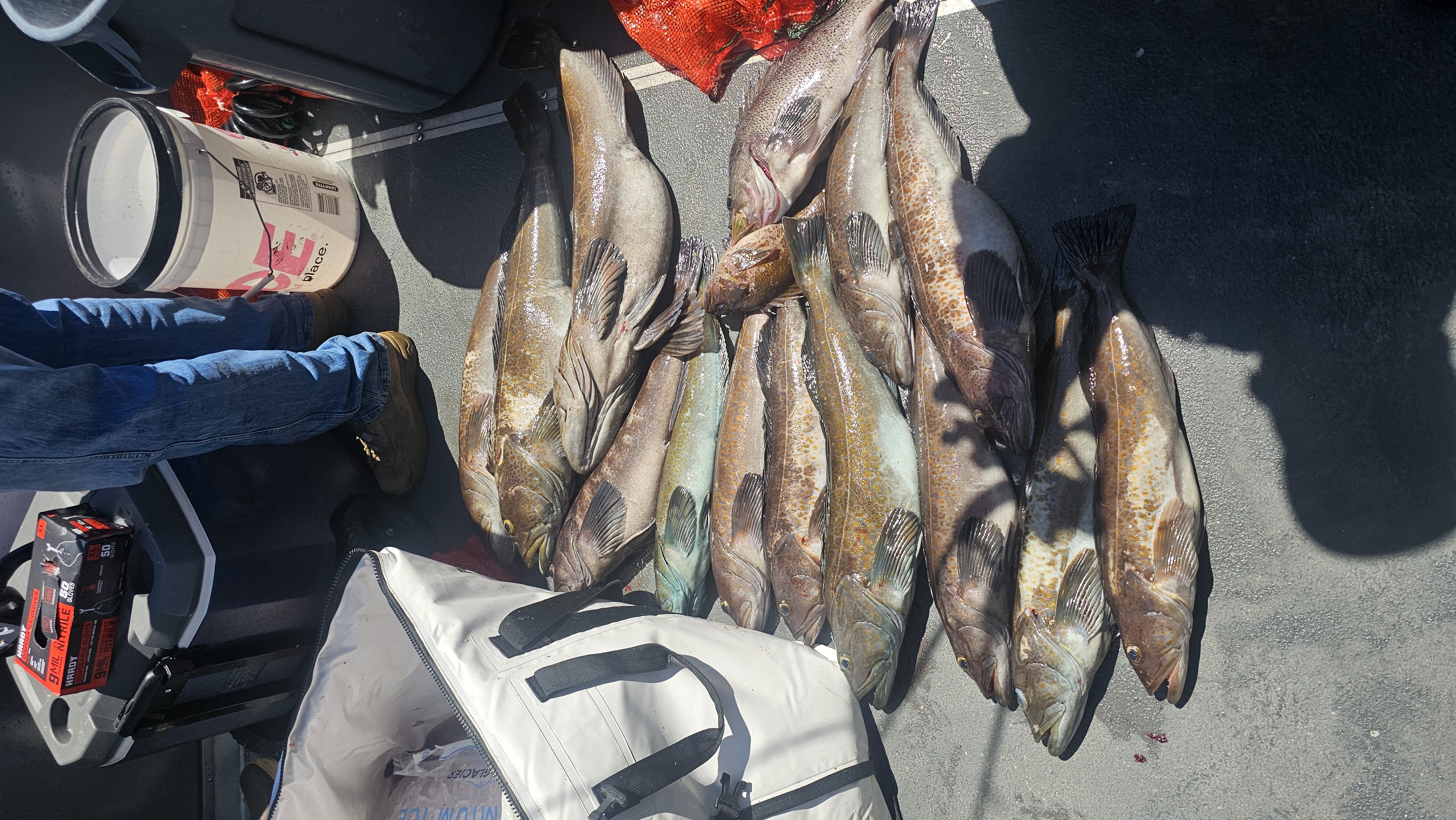
BODEGA BAY – The New Sea Angler has been finding superb action on shallow water rockfish and lingcod off the Sonoma County Coast
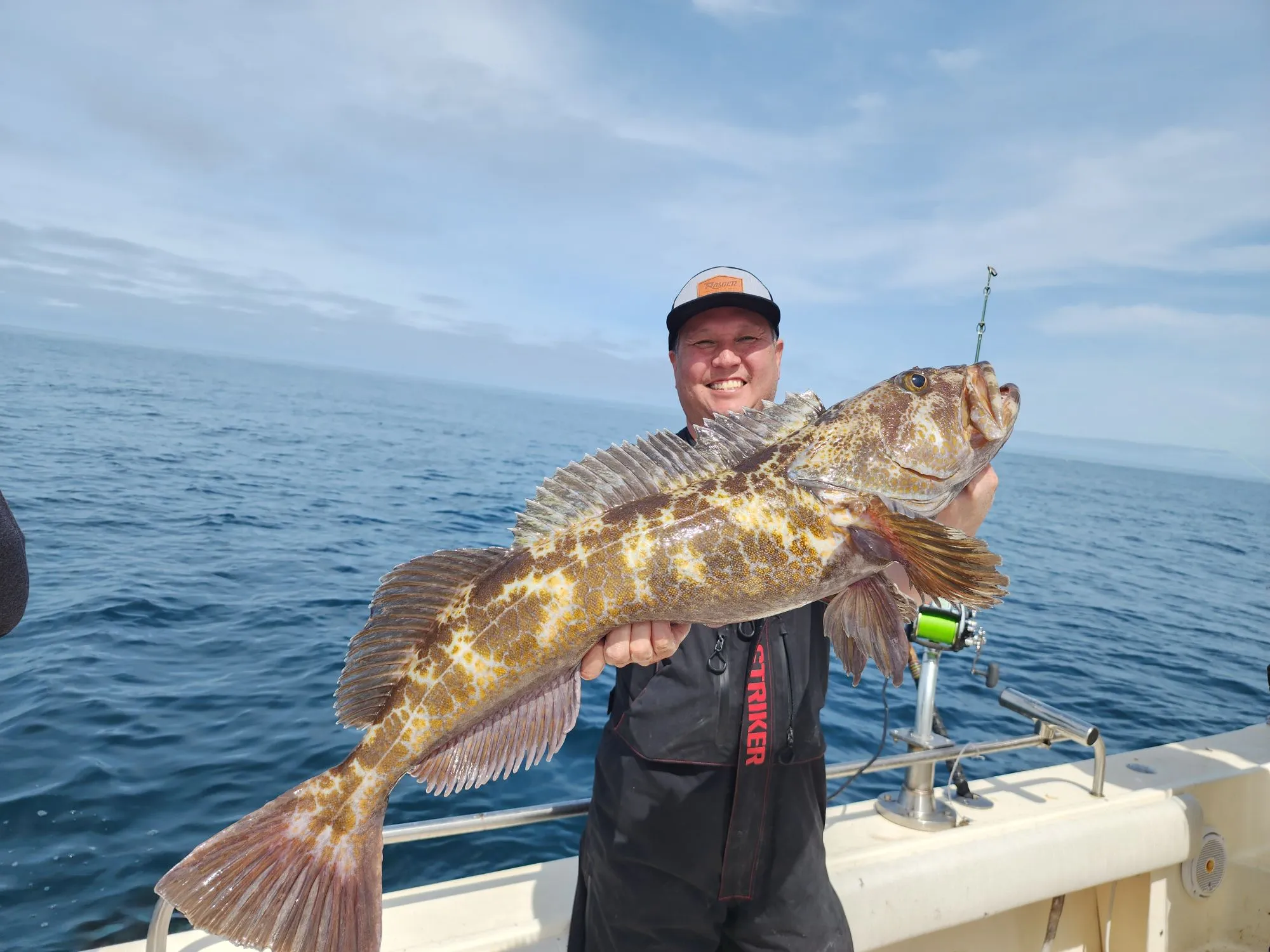
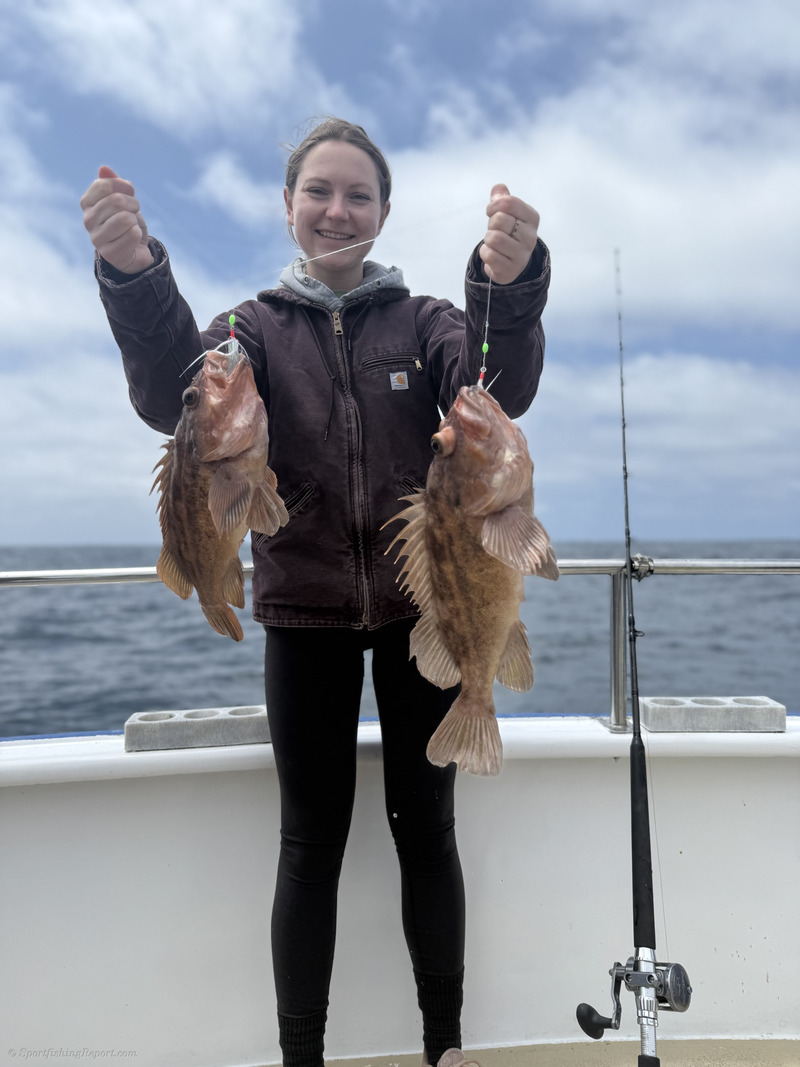
“The fishing has been phenomenal,” said Captain Rick Powers of Bodega Bay Sportfishing on July 6. “We’ve been catching limits of shallow water rockfish every day, along with an average of one lingcod per rod. We have been catching quality canary, brown, copper and vermilion rockfish – no school fish.”
On his latest fishing trip, the 8 anglers aboard the New Sea Angler landed 80 rockfish and 10 lingcod to 14 pounds. On his previous trip, the 16 anglers bagged 160 rockfish and 16 lingcod to 15 pounds.
Anglers are using an array of offerings for the bottomfish, including baited shrimp flies, bars, jigs and swimbaits.
The recreational groundfish regulations in the San Francisco Management Area (from Point Arena to Pigeon Point) are available here: https://nrm.dfg.ca.gov/FileHandler.ashx?DocumentID=185056&inline
Powers fished both days during the opening weekend of the limited salmon season on June 7 and 8. The boat returned to the dock with 4 Chinook salmon to 9 pounds for the 25 anglers aboard the New Sea Angler on June 7 and 11 Chinook salmon to 12 pounds on June 8. They trolled with anchovies off the Sonoma County Coast.
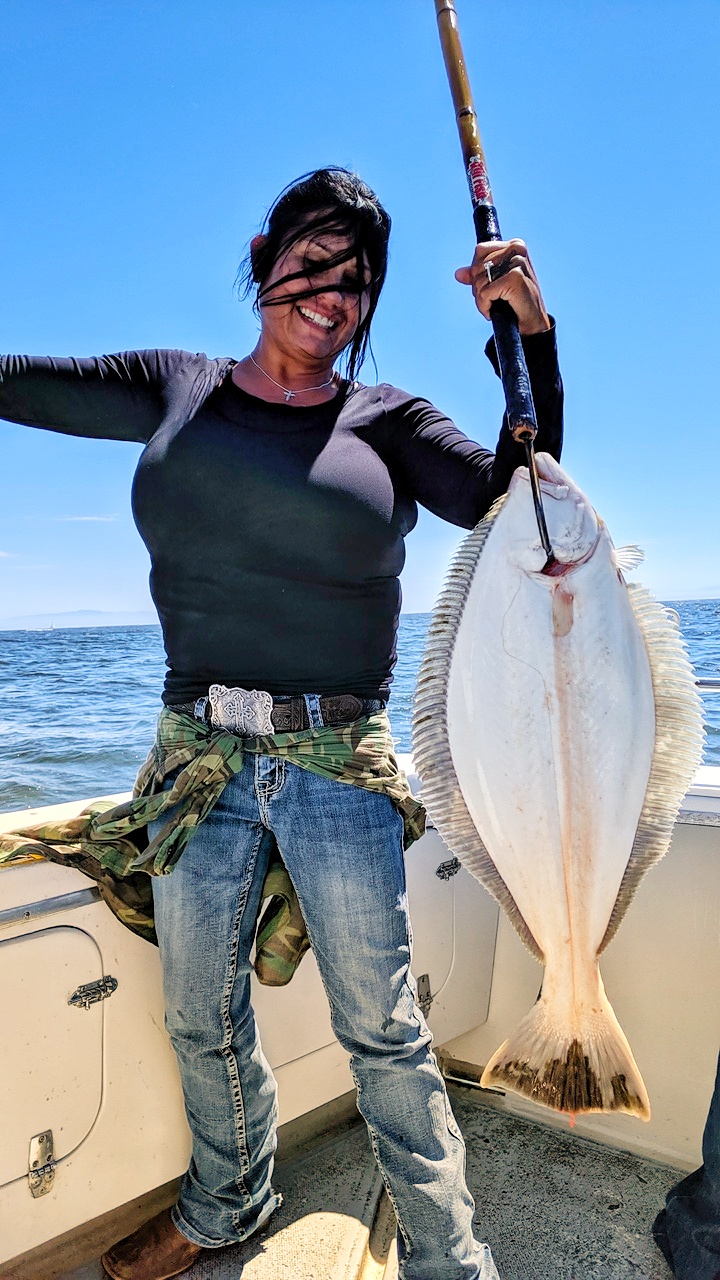
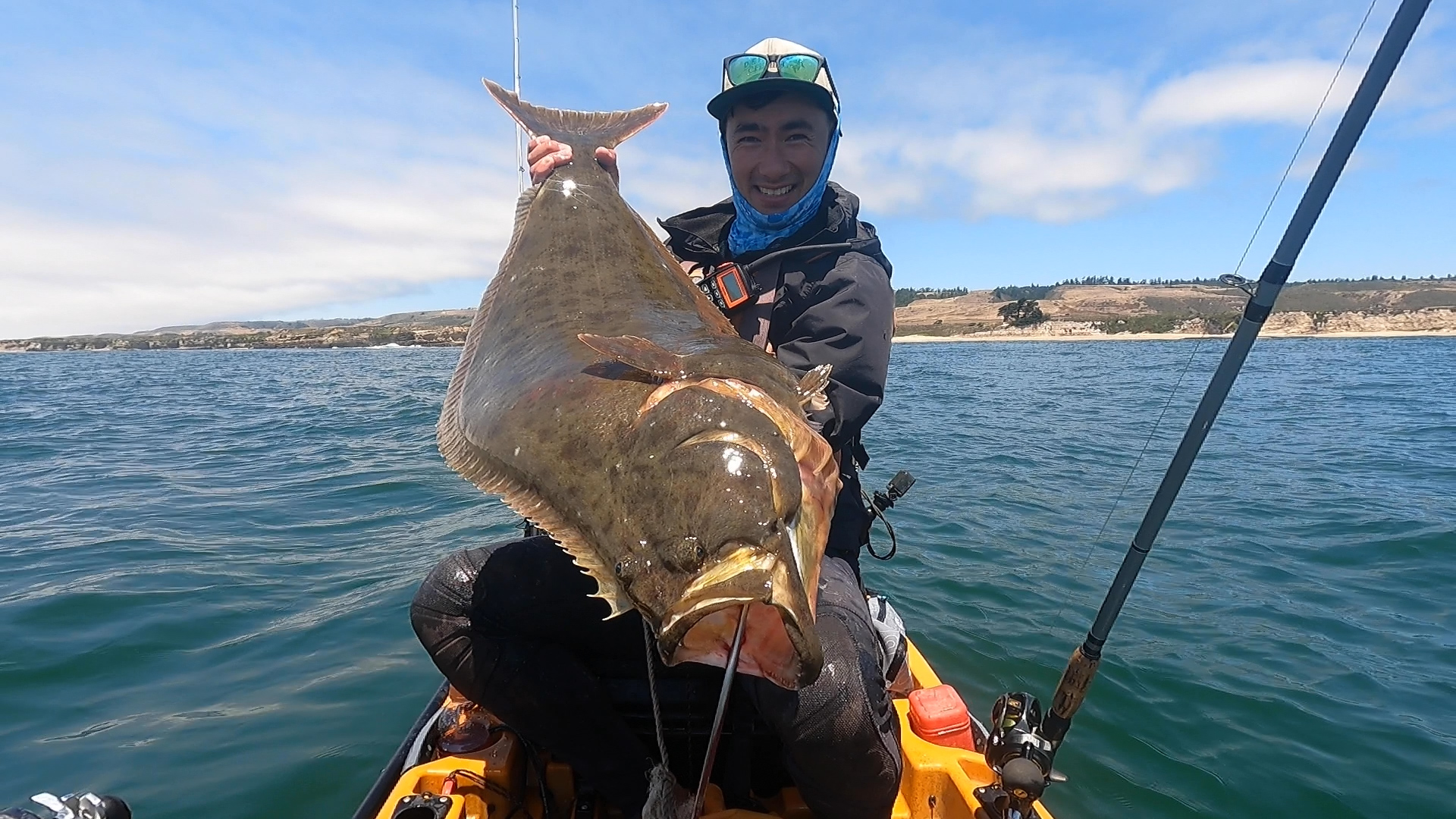
Anglers are beginning to pick up some halibut out of Lawson’s Landing on Tomales Bay. Mike Mack caught a 28 lb. halibut on July 4, the largest one weighed in this year to date.
“I don’t know what bait and where he caught it, but I suspect a jacksmelt and near Hog Island, as that has been his method as of late,” said Vogler.
Big fish honors also go to Cannon Brunkhorst who caught a 20 lb. halibut. The fish hit dead bait hunkered down in 47 feet of water.
Oscar and Angela Aceves landed a 15 lb. white seabass while trolling bait near Marconi. “I’ve heard about a couple of these being caught in the last month, but this is the first one hung on the scale here this year,” Vogler reported.
“Oscar Aceves had a pair of halibut from Marconi and Gage and I caught three halibut and a striper at Hog, but I heard of no other action,” said Vogler after a trip he made on the bay.
“Quinn and Dave came out to see if the surf had any stripers in it,” Vogler added. “Dave caught a couple almost immediately and released them, but after Quinn fought a 29 pounder for a half hour, he decided to keep it. That’s a big striper for here and a huge striper for here in the surf,” he stated.
Fisherman’s Wharf/Berkeley Live Bait Drifters Battle Stripers and Halibut
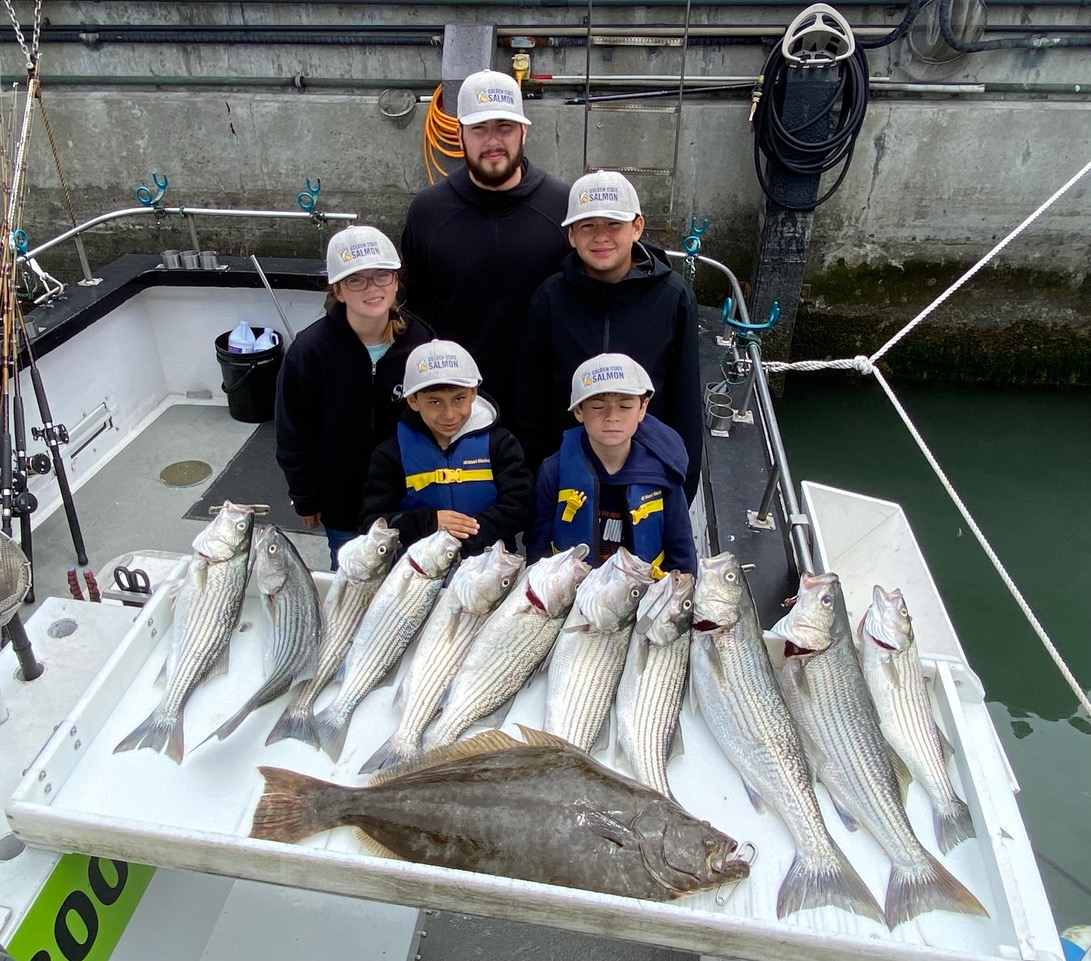
SAN FRANCISCO – Anglers targeting striped bass, halibut and leopard sharks are experiencing stellar fishing on San Francisco Bay and in the ocean just outside of the Golden Gate. “What an epic bite today,” reported Captain James Smith of California Dawn Sportfishing on Sunday, July 6. “Both boats checked in with limits of jumbo halibut and the California Dawn 1 checked in with limits of bass as well. We got ‘em big time in the ocean.” The final count for the California Dawn 1 was 22 limits of striped bass (44) to 15 pounds and 22 limits of halibut (44) to 31 pounds. The California Dawn 2 came back with 26 limits of halibut (52) to 30 pounds.
Captain Craig Hansen of Argo Sportfishing said he’s been putting his customers on both halibut and striped bass in numerous locations. F-Buoy and the Berkeley Flats, the backside and frontside of Alcatraz Island, and the south side of Angel Island have all been productive. The key, according to Capt. Craig, is to move around to these locations until you find the fish. Other locations that can be very productive, if the weather and ocean conditions cooperate, is the north and south bars out the Golden Gate on the outgoing tide.
Meanwhile Captain Ron Koyasako of Nautilus Excursions said he’s been targeting mainly stripers for his clients in the bay, but when the tides and ocean conditions look good, he’s been drifting Seal Rock and the north and south Bars out the Gate (see the attached photos).
Also in the bay, Captain Steve Talmadge of Flash Sportfishing Charters stated that he has been drifting live bait targeting halibut and striped bass for his customers. Capt. Steve also said, as a change of pace, he has also been navigating down to the south bay for excellent leopard shark fishing. Capt. Steve added that he has been anchoring at Hunters Point or off of Oracle Park in 50 feet of water for excellent leopard shark fishing (see the attached photos). He’s been soaking salmon roe and squid to entice the leopards.
Now a salmon report. The June 7th and 8th opener was epic for some, with fast limits for those anglers motoring south of the Golden Gate, and fair for other harbors north of the Gate. The Department of Fish and Wildlife (CDFW) has announced that the harvest deadline of 7,000 Chinook salmon has been met in the first opener, so it will not open for additional days in July or August. The CDFW further announced that the Chinook salmon fishery will reopen for four days on September 4-7, 2025 between Point Reyes and Point Sur under a fall harvest guideline of 7,500 Chinook salmon. For further information call the CDFW Ocean Salmon Hotline at (707) 576-3429.
If you would like to fish with any of these Captains or Guides, just do a search on the internet for their contact information.
If you would like more information about the California Striped Bass Association (CSBA), go to our website (www.striper-csba.org). You will be able to access all the information related to the 4 CSBA Chapters. New members only pay $25, that includes a one-time $5 initiation fee. After the first year of membership the annual dues are only $20.
Your membership helps to strengthen our mission to protect striped bass and our fisheries. Some Chapters will give you a free gift just for joining. The Isleton-Delta Chapter gives all new members two free Isleton Chapter decals and a Chapter hat as a thank you for joining our Chapter. Membership forms are available for each Chapter on the website. Just click on your Chapter of choice and go to the membership page, fill out the application, print it and send your application and payment to the address listed on the application.
The Isleton Chapter accepts credit cards online on the website for new memberships, membership renewals as well as our chapter’s events. The website also has Chapters’ newsletters, photos, interesting articles, and useful links that will help you plan your next fishing trip. – Ken Baccetti, President of the California Striped Bass Association (CSBA), Isleton-Delta Chapter.
Monterey Bay Rockfish Enthusiasts Target Coastal Reefs
MONTEREY – Full limits of rockfish, along with a few lingcod, are the rule for charter boats departing from Monterey.
The 26 anglers aboard the Checkmate on July 5 landed limits of rockfish (260) and 2 lingcod. The 20 anglers aboard the Carline landed limits of rockfish (200) the same day, according to Steve Semler at Chris’ Fishing Trips.
The 21 anglers aboard the Checkmate celebrated the Fourth of July by bagging limits of rockfish and 7 lingcod.
The anglers have been fishing in less than 20 fathoms of water with shrimp flies, bars, jigs, swimbaits and Point Wilson Darts. Blues, blacks and vermilions are making up most of the rockfish bag limits,
The rockfish season will continue to run through Dec. 30, 2025. Here are the depth restrictions now in place:
May 1 – Sept. 30: 20 fathoms inshore fishery
Oct 1 – Oct. 31: 50 fathoms offshore only fishery
Nov. 1 – Nov. 30: 20 fathoms inshore only fishery
Dec. 1 – Dec. 31: 50 fathoms offshore only fishery
Salmon fishing was great on the opening day of the limited salmon season on June 7. The 25 anglers aboard the Checkmate came back with 46 kings, just four fish short of full limits. Fishing was much slower on the following day; the Checkmate checked in with 2 salmon, while the Caroline didn’t return with any salmon.
The quota of 7,000 fish was reached for the summer salmon season.
Rockfish action is also going strong off Santa Cruz. “The rockfishing was good near 4 Mile Beach in the morning before the wind came up,” said Todd Fraser at Bayside Marine on July 5.
“The halibut are still being caught near Capitola and Pajaro. The anglers reported a little better action on halibut since the swell dropped today. The halibut fishing was better in the 50-80 foot range due to the south swell. The wind did blow in the late morning. There were some striped bass caught near Rio del Mar and Manresa by anglers tossing out plugs, swimbaits and other lures,” he added
Stagnaro’s Fishing Trips is now booking 4.5 hour nearshore rockcod trips on weekdays and 6 hour rockfish trips on Saturdays and Sundays, as well as twilight trips on Saturdays. Their latest 4.5-hour rockfish trip yielded 70 rockfish and 5 lingcod. Their most recent twilight trip produced 98 rockfish, while their last 6-hour trip yielded 108 rockfish and 5 lingcod.